For most archaeological discoveries, the greatest challenge is preservation. Buildings collapse, wood decays, and metal is recycled, leaving historians with only fragments of the past. When an object survives intact, identifying its purpose is usually much easier. Its context, written records, or artistic depictions often provide enough evidence to place it within everyday life.
The Roman dodecahedron presents a very different problem.
More than one hundred examples have been discovered across Europe over the last three centuries. They are remarkably similar in shape, carefully manufactured from bronze, and date primarily to the second and third centuries AD. Despite this abundance of physical evidence, there is still no widely accepted explanation for their purpose.
The mystery is therefore not created by a lack of artifacts but by a lack of context. Archaeologists possess the objects themselves, yet almost every question surrounding their use remains open.
An Object with a Surprisingly Consistent Design
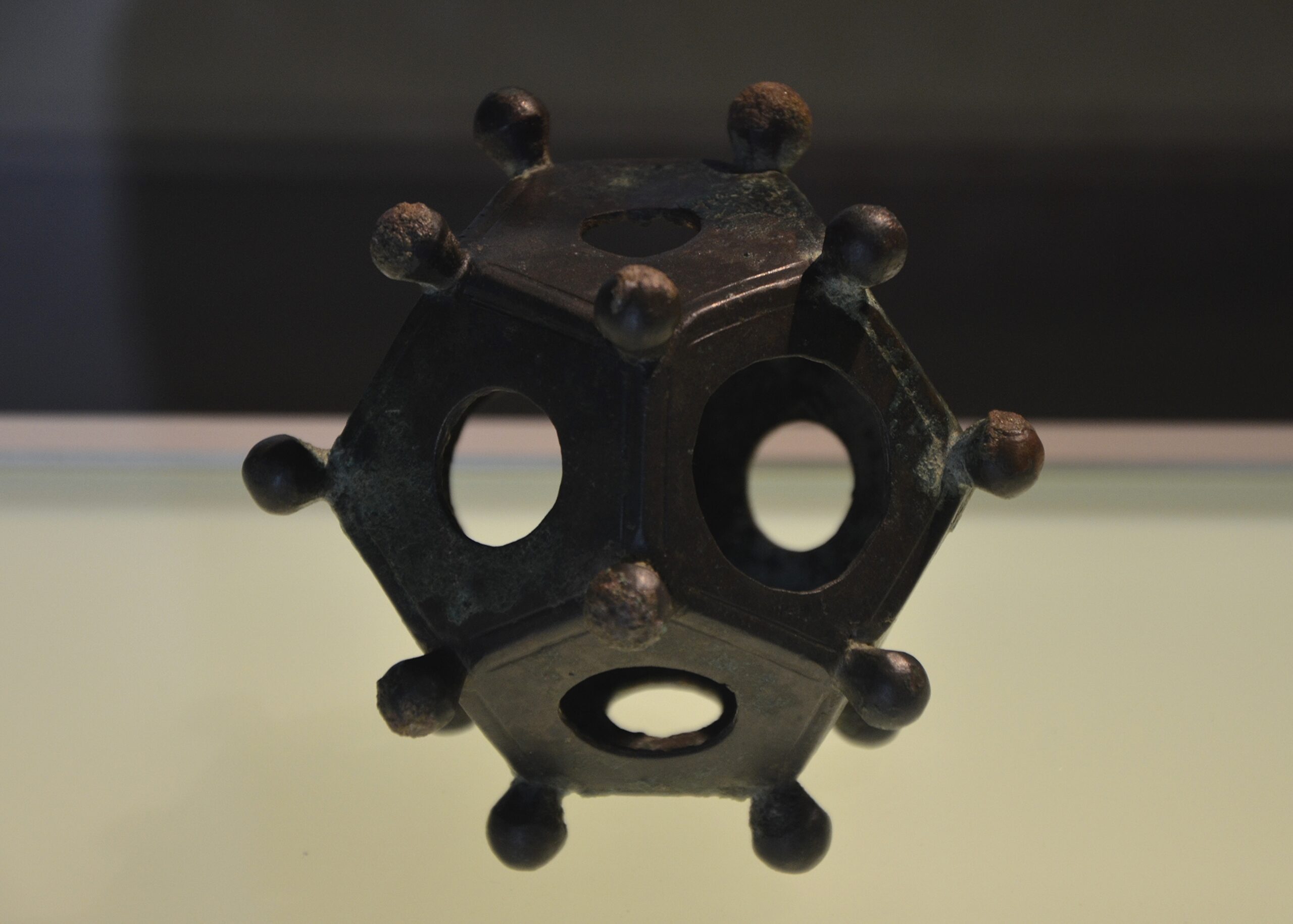
Every Roman dodecahedron follows the same basic pattern.
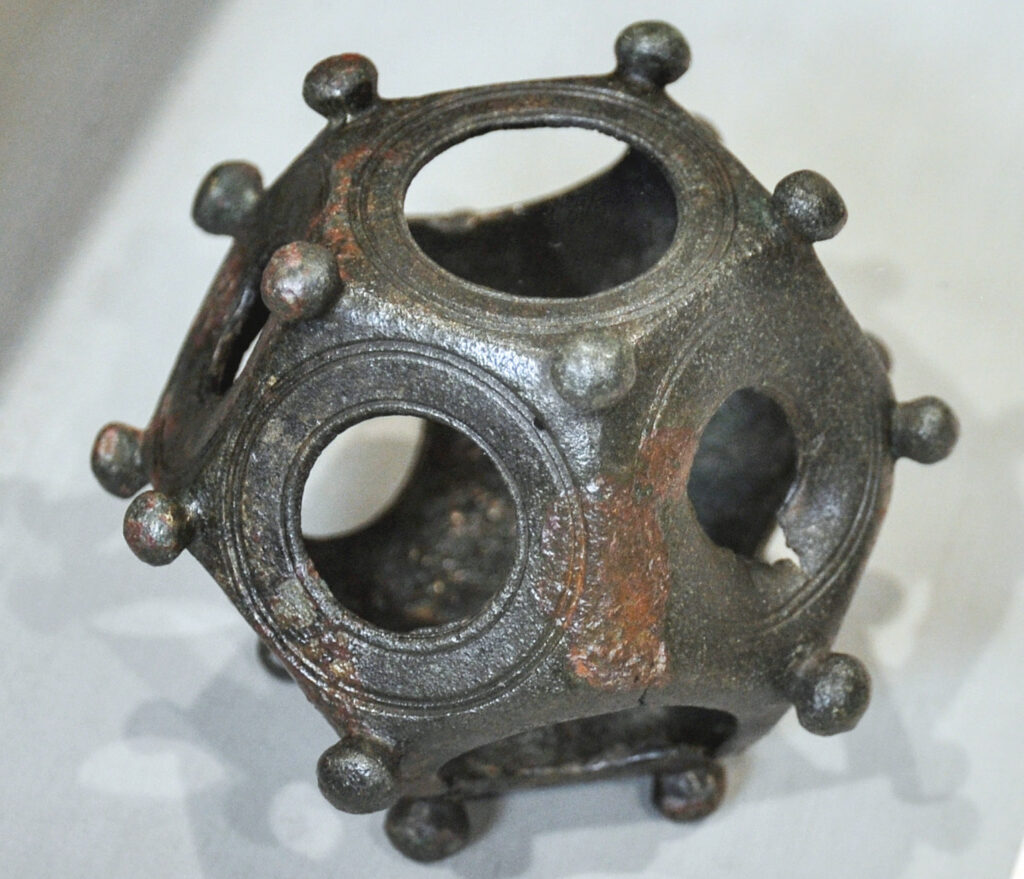
It consists of twelve pentagonal faces connected into a hollow geometric shape. Each face contains a circular opening, but the diameter of these openings varies from one side to another. At every corner sits a rounded knob cast as part of the original object.
Most surviving examples measure between four and eleven centimeters in diameter and are made from bronze using sophisticated casting techniques. Although individual pieces differ in decoration and exact dimensions, the overall design remains remarkably consistent.
This consistency immediately suggests that the objects were manufactured according to a recognizable pattern rather than created as individual works of art.
The question is whether that pattern served a practical function, a symbolic purpose, or something that combined elements of both.
Where Have They Been Found?
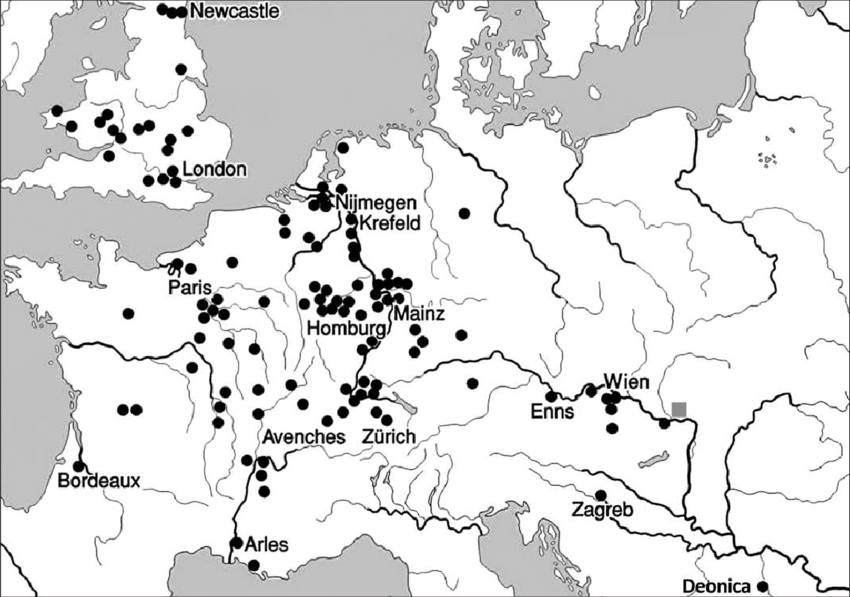
One of the most interesting characteristics of Roman dodecahedrons is their geographical distribution.
Examples have been recovered from archaeological sites in modern-day England, France, Belgium, Germany, Luxembourg, Switzerland, Austria, and Hungary. Almost all discoveries fall within the northwestern provinces of the Roman Empire.
This pattern is difficult to ignore. If the objects represented a universal Roman tool, they would be expected throughout Italy, Spain, North Africa, and the eastern Mediterranean as well. Instead, they appear concentrated in a relatively limited region.
The objects may have been associated with local traditions that never spread across the entire empire. They may have been produced in regional workshops serving a specific profession or community. Another possibility is that they belonged to military units stationed along the northern frontier, explaining why so many examples have been recovered from provinces connected to the Rhine frontier.
At present, the available evidence is insufficient to distinguish confidently between these possibilities. The distribution nevertheless provides an important clue: whatever their purpose, Roman dodecahedrons were unlikely to be random decorative curiosities.
Precision That Suggests a Purpose
The more closely archaeologists examine these objects, the more deliberate their construction appears.
The openings are carefully positioned and vary in diameter according to a consistent pattern. The knobs occupy symmetrical positions at every vertex, creating an object that can be rotated and viewed from multiple angles while maintaining balance.
Producing such geometry in bronze required skilled craftsmanship. A mold had to be prepared with considerable accuracy, followed by finishing work to ensure that the openings and edges retained their intended proportions.
The precision of its construction suggests that appearance alone was probably not the primary objective. Whether that precision served a practical, symbolic, or ceremonial purpose remains the central question.
Decorative objects often tolerate small imperfections without losing their value. Measuring instruments, alignment tools, or specialized equipment, however, depend much more heavily on consistent dimensions and careful manufacturing.
The design therefore encourages functional interpretations, even if the exact function remains uncertain.
The Measuring Instrument Theory
Among the many proposed explanations, one has attracted particular attention because it can be tested experimentally.
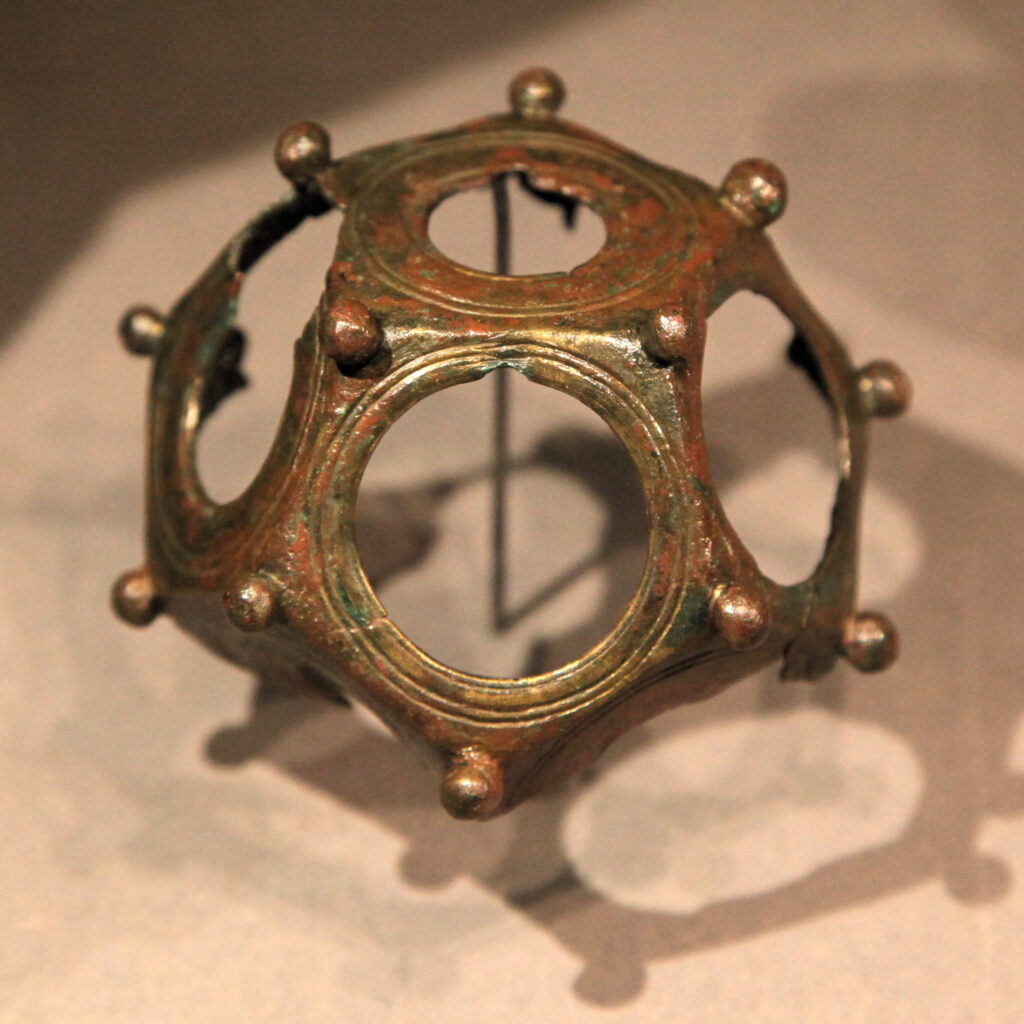
The different hole sizes allow a user to look through pairs of opposite openings, creating fields of view with changing angles. If the size of a distant object is already known, those angles could theoretically be used to estimate distance using simple geometry.
Modern researchers and enthusiasts have successfully demonstrated that replicas of Roman dodecahedrons can perform this task with reasonable accuracy.
The idea is attractive because it explains several otherwise puzzling design choices. Different hole diameters would provide different measuring ranges, while the symmetrical shape would allow multiple combinations without requiring moving parts.
The theory also fits comfortably within Roman engineering traditions. Roman surveyors, architects, and military engineers regularly employed practical geometry in construction, road building, and artillery deployment.
Yet significant problems remain.
No surviving Roman manual describes such an instrument, no inscription identifies its purpose, and the dimensions of surviving examples are not standardized to the degree normally expected for measuring equipment. The theory is therefore plausible but not proven.
Other Theories: From Gloves to Ritual Objects
The measuring instrument hypothesis is not the only explanation that has attracted attention. Over the years, archaeologists, historians, engineers, and hobbyists have proposed dozens of alternatives, each attempting to account for the unusual combination of geometry, varying hole sizes, and bronze construction.
One of the more practical ideas emerged from the world of textile crafts. Using modern replicas, several researchers demonstrated that the object can be used to knit gloves. Yarn is threaded through different openings, with each hole producing a finger of a slightly different diameter. The result is a surprisingly efficient way to create gloves in multiple sizes using a single tool.
The demonstration proves that a Roman dodecahedron can perform this function. Whether it was originally designed for textile production is a different question.
No examples have been recovered from workshops associated with weaving or knitting, nor have archaeologists found yarn residues or other direct evidence connecting the objects to textile manufacture. As with the measuring theory, the idea remains plausible but unconfirmed.
Other interpretations place the objects in religious or ceremonial settings. Several dodecahedrons have been discovered together with coins or other valuable items, suggesting that they may have been deposited intentionally rather than discarded. Their symmetrical form and careful manufacture could indicate symbolic significance, perhaps associated with local religious practices that left little documentary evidence.
Unlike the Greek world, where geometry often carried philosophical meaning, the northwestern provinces of the Roman Empire combined Roman traditions with Celtic cultures and local beliefs. A ceremonial object belonging to these communities would not necessarily appear in surviving Latin literature or official Roman records.
The difficulty is that every theory explains some features while leaving others unanswered. None accounts equally well for the geographical distribution, the varying hole sizes, the bronze construction, and the absence of written descriptions.
Why Is It Still a Mystery?
Most archaeological objects can be identified because different types of evidence support one another. Written records describe their purpose, artistic depictions show them in use, and archaeological context reveals where they were used or stored. Even when one source is missing, the remaining evidence is often sufficient to reconstruct an object’s original function.
The Roman dodecahedron is unusual because almost none of these supporting sources exist. No surviving Roman author describes such an object, no sculpture or mosaic clearly depicts it in use, and most examples have been recovered as isolated finds rather than from clearly identifiable workshops or temples. As a result, archaeologists must rely almost entirely on the objects themselves when attempting to explain their purpose.
More than one hundred dodecahedrons have survived, providing an unusually large collection of artifacts for study. The difficulty lies not in the number of discoveries, but in the absence of historical information connecting those discoveries to everyday Roman life. It is entirely possible that the objects once served a practical function that every user understood, making written explanations unnecessary. If that knowledge disappeared as the communities that used them vanished, the objects would survive while their original purpose was gradually forgotten.
Distribution of Roman Dodecahedron Discoveries
What the Roman Dodecahedron Tells Us
Popular history often focuses on monumental structures, lost cities, and spectacular archaeological discoveries. The Roman dodecahedron offers a different perspective.
It is small enough to fit comfortably in one hand, yet it raises questions that remain unanswered despite more than a century of research. Its survival demonstrates the skill of Roman metalworkers, while its unexplained purpose reminds us that archaeological evidence is always incomplete.
History is reconstructed from fragments.
Sometimes those fragments include buildings, inscriptions, and written accounts that fit together into a coherent narrative. At other times, they leave behind only an object without the knowledge that once surrounded it.
The Roman dodecahedron belongs to the second category.
Its existence does not require forgotten civilizations, impossible technology, or extraordinary explanations. It simply illustrates a more familiar reality: knowledge can disappear when the communities that created it vanish and the practical traditions that gave objects their meaning are no longer passed from one generation to the next.
That conclusion may be less dramatic than many speculative theories, but it is arguably more interesting. Rather than presenting an impossible artifact, the Roman dodecahedron reveals the limits of our historical understanding and reminds us that even a civilization as well documented as Rome can still leave behind unanswered questions.
Common Questions About the Roman Dodecahedron
What is a Roman dodecahedron?
A Roman dodecahedron is a small hollow bronze object with twelve pentagonal faces, circular holes of different sizes, and rounded knobs at each corner. More than one hundred examples have been discovered across Europe.
What was a Roman dodecahedron used for?
Its purpose remains unknown. Proposed explanations include a measuring instrument, textile tool, religious object, or ceremonial artifact, but none has been conclusively proven.
Where have Roman dodecahedrons been found?
Most discoveries come from former Roman provinces in modern-day England, France, Belgium, Germany, Switzerland, Austria, and Hungary.
How old are Roman dodecahedrons?
Most known examples date from the second to fourth centuries AD, during the later period of the Roman Empire.
Why is the Roman dodecahedron still a mystery?
No surviving Roman text, inscription, or artwork explains its function, forcing archaeologists to interpret the objects almost entirely through their physical characteristics and archaeological context.