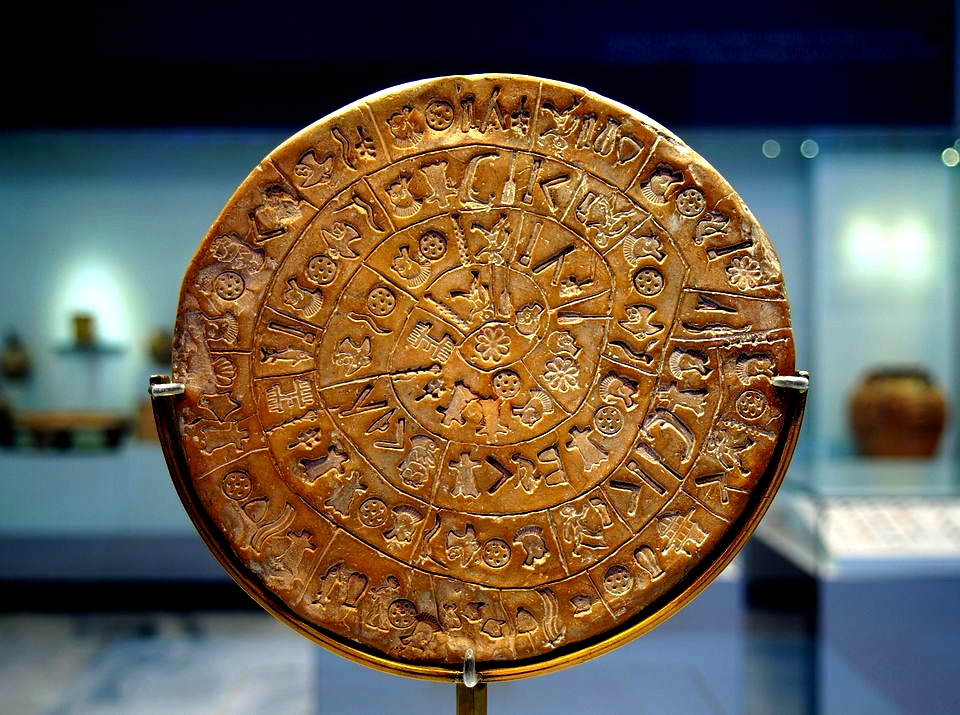
Hidden among the ruins of a Bronze Age palace on the island of Crete lies one of archaeology’s most enduring mysteries. Unlike inscriptions carved into stone or written on clay tablets, the Phaistos Disc bears symbols that appear nowhere else in the ancient world. More than a century after its discovery, no one has been able to read its message with confidence.
The disc has inspired countless attempts at decipherment. Some researchers have argued that it preserves an unknown language, others believe it records a religious hymn, while more speculative theories have linked it to Atlantis or even visitors from beyond Earth. Yet despite these competing interpretations, one fact remains unchanged: no proposed translation has gained acceptance among specialists.
The true significance of the Phaistos Disc does not lie in extraordinary speculation. Instead, it highlights the limits of our knowledge and demonstrates how even a single surviving artifact can raise questions that archaeology cannot yet answer.
The Discovery at the Palace of Phaistos
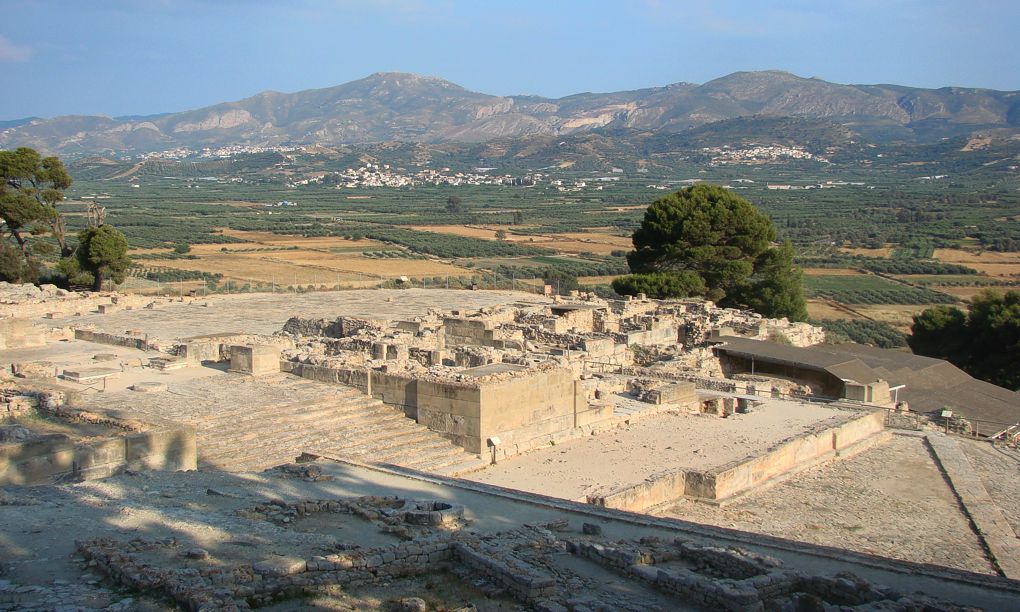
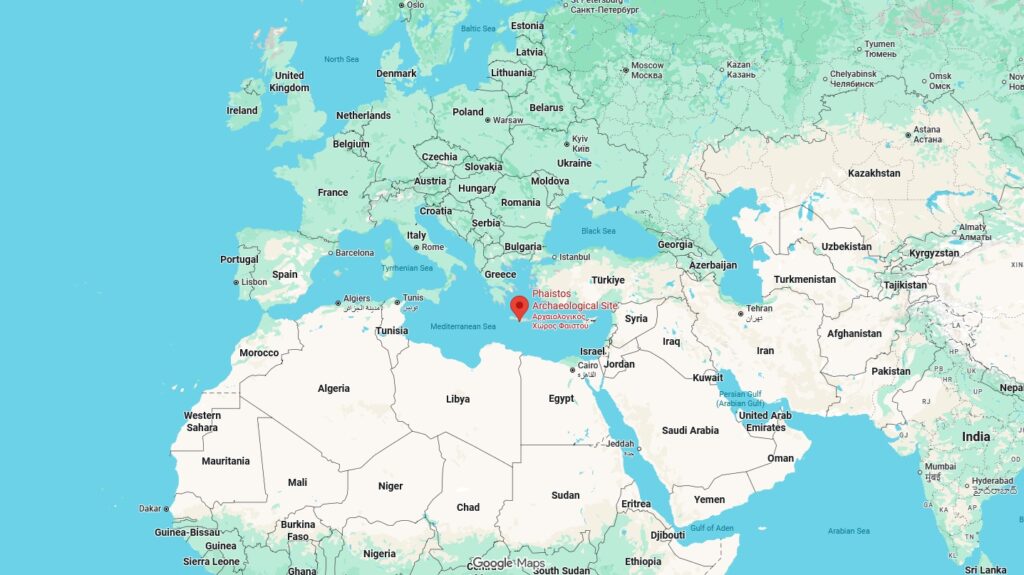
The Phaistos Disc was discovered on 3 July 1908 by the Italian archaeologist Luigi Pernier during excavations at the Minoan palace of Phaistos in southern Crete.
Unlike many famous archaeological finds recovered from tombs or treasure hoards, the disc was found inside the remains of a building associated with the palace complex. It had been carefully preserved by the destruction of the structure, allowing it to survive for more than three thousand years.
Nearby, archaeologists also uncovered a clay tablet written in Linear A, another undeciphered script of Minoan Crete. Although the two objects were found in the same general area, there is no evidence that they contain the same language or served the same purpose.
Radiocarbon dating cannot be applied directly to fired clay, but archaeological evidence places the disc in the Middle or Late Bronze Age, approximately between 1850 and 1600 BC.
Rather than appearing as an isolated curiosity, the Phaistos Disc belongs to one of Europe’s most sophisticated prehistoric civilizations.
What Makes the Phaistos Disc Unique?
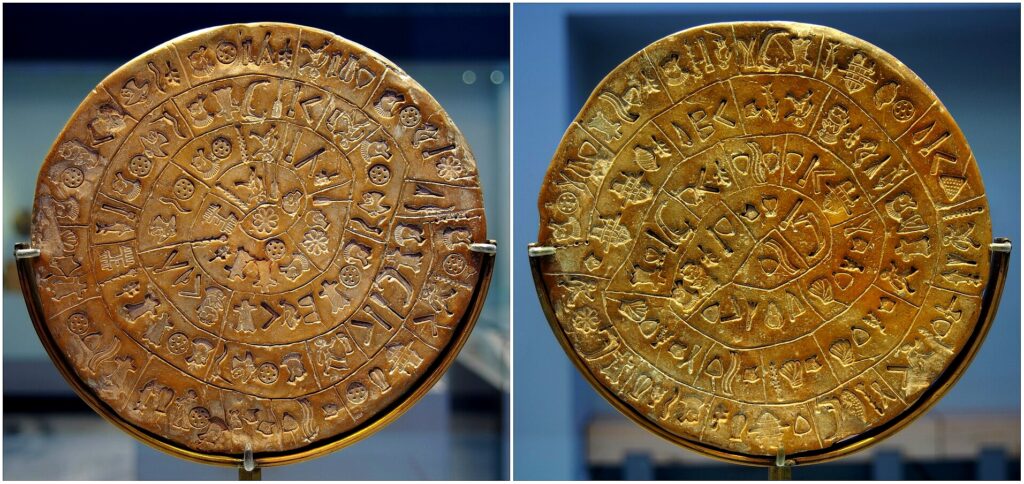
At first glance, the Phaistos Disc appears surprisingly simple. It is a circular clay disc measuring approximately 16 centimeters in diameter, covered on both sides with symbols arranged in a spiral that leads toward the center.
A closer examination reveals what makes the artifact truly extraordinary. Instead of carving each sign by hand, the creator impressed individual symbols into the soft clay using small stamps before the disc was fired. In total, the text contains 241 impressions made from 45 different symbols, including human figures, animals, plants, tools, and geometric shapes. This method is unique in Bronze Age archaeology.
Because the symbols were stamped rather than engraved, some researchers have described the Phaistos Disc as one of the earliest known examples of movable type. While this comparison should not be taken too literally—the process differs significantly from Gutenberg’s printing press—it illustrates how unusual the manufacturing technique was for its time.
Equally remarkable is the fact that no other object using the same system has ever been discovered. Archaeologists have uncovered thousands of inscriptions written in Egyptian hieroglyphs, cuneiform, Linear A, and Linear B, yet the Phaistos Disc remains completely alone. Without additional examples for comparison, determining the meaning of its symbols becomes extraordinarily difficult.
Why Can’t We Read It?
Many ancient writing systems remained undeciphered for centuries before finally yielding their secrets. Egyptian hieroglyphs were understood after the discovery of the Rosetta Stone, while Linear B was successfully deciphered in the 1950s by Michael Ventris because hundreds of clay tablets provided enough material for comparison.
The Phaistos Disc presents a very different challenge. The entire inscription contains only 241 symbols, far too little text for linguists to identify repeating grammatical structures with confidence. Even more importantly, there are no parallel inscriptions written in another known language that could serve as a key to its interpretation. The problem becomes even greater because the underlying language itself remains unknown.
Although the disc was discovered within a Minoan palace, there is no certainty that it records the same language represented by Linear A. It could preserve a different local language, a ceremonial text, or even an imported inscription created elsewhere in the eastern Mediterranean. Each of these possibilities has been proposed, yet none can currently be demonstrated.
For this reason, every claimed translation encounters the same obstacle. Without independent evidence confirming the language or the meaning of individual symbols, any interpretation risks becoming an exercise in educated guesswork rather than a genuine decipherment.
Theories and Failed Decipherments
During the past century, hundreds of researchers and enthusiasts have claimed to solve the mystery of the Phaistos Disc.
Some have interpreted it as a religious hymn dedicated to a Minoan goddess. Others believe it records a calendar, a legal document, a military record, or a prayer used during ceremonies. More speculative proposals have connected the disc to Atlantis, extraterrestrial visitors, or forgotten civilizations possessing advanced knowledge.
These ideas differ dramatically, yet they share a common weakness. Each begins by assuming a particular language or historical context before attempting to assign meanings to the symbols. Once those assumptions change, the entire translation changes with them.
Professional linguists therefore apply a much stricter standard. A successful decipherment must explain every symbol consistently, produce meaningful grammar, fit the archaeological context, and make testable predictions that can be verified using independent evidence. No proposed translation of the Phaistos Disc has yet met those requirements.
The absence of an accepted translation does not mean the inscription is impossible to read. It simply reflects the current state of the available evidence.
As with many archaeological mysteries, the greatest obstacle is not a lack of imagination but a lack of comparable material.
Palace of Phaistos, Crete
Could It Be a Hoax?
Because the Phaistos Disc is unique, some researchers have questioned whether it is genuine at all.
Unlike Egyptian hieroglyphs or Mesopotamian cuneiform, which appear on thousands of surviving inscriptions, the symbols on the Phaistos Disc have never been found on another object in the same arrangement. This unusual situation has led a small number of scholars to suggest that the disc might be a modern creation rather than a Bronze Age artifact.
Several arguments have been put forward in support of this idea. The disc was discovered in 1908, during a period when archaeological excavations across the eastern Mediterranean were uncovering spectacular new finds. Its unique appearance immediately attracted international attention, and because no similar object had ever been found, some critics argued that its creator—if modern—would have had complete freedom to invent an entirely new writing system. Most archaeologists, however, reject the hoax hypothesis.
The fired clay, manufacturing technique, and archaeological context all fit comfortably within the Bronze Age world of Minoan Crete. Scientific examinations have found no convincing evidence of modern production, and creating such a forgery would have required an extraordinary understanding of Minoan material culture at a time when much of that culture was still poorly understood.
While it is impossible to prove beyond all doubt that the disc is authentic, the overwhelming majority of specialists consider it a genuine Bronze Age artifact. The real mystery is therefore not whether the disc is ancient, but what its inscription was intended to communicate.
What the Phaistos Disc Really Tells Us
The Phaistos Disc occupies a unique position in archaeology because it demonstrates both the power and the limitations of historical research.
Modern technology allows scientists to determine the composition of the clay, examine microscopic manufacturing marks, reconstruct the circumstances of its discovery, and compare its symbols with other Bronze Age writing systems. These methods reveal a great deal about how the object was made and the civilization that produced it.
Yet they cannot answer the most obvious question.
What does the inscription actually say?
This uncertainty serves as an important reminder that archaeology depends not only on the survival of artifacts but also on the survival of information. A single missing link—a bilingual inscription, another example of the same script, or a larger collection of related texts—could completely transform our understanding of the Phaistos Disc.
Until such evidence is discovered, every proposed translation must remain a hypothesis rather than an established fact.
Rather than representing a failure of archaeology, the Phaistos Disc illustrates how historical knowledge develops. New discoveries rarely answer every question immediately. Instead, they provide pieces of a much larger puzzle that may take decades, or even centuries, to assemble.
For now, the Phaistos Disc continues to remind us that even in one of the world’s best-studied ancient civilizations, there are still voices from the past that we cannot yet understand.
Common Questions About the Phaistos Disc
What is the Phaistos Disc?
The Phaistos Disc is a circular clay artifact discovered in the Minoan palace of Phaistos on Crete in 1908. It contains a spiral arrangement of stamped symbols that has never been successfully deciphered.
How old is the Phaistos Disc?
Most archaeologists date the disc to the Middle or Late Bronze Age, approximately 1850–1600 BC.
Has the Phaistos Disc been translated?
No. Although hundreds of translations have been proposed, none has been accepted by the scholarly community because there is insufficient evidence to verify any interpretation.
Why is the Phaistos Disc unique?
It is the only known artifact bearing this particular combination of symbols and one of the earliest known examples of text created using individually stamped signs rather than hand-carved characters.
Is the Phaistos Disc a hoax?
A small minority of researchers have questioned its authenticity, but the overwhelming majority of archaeologists consider it a genuine Bronze Age artifact based on its material, manufacturing technique, and archaeological context.