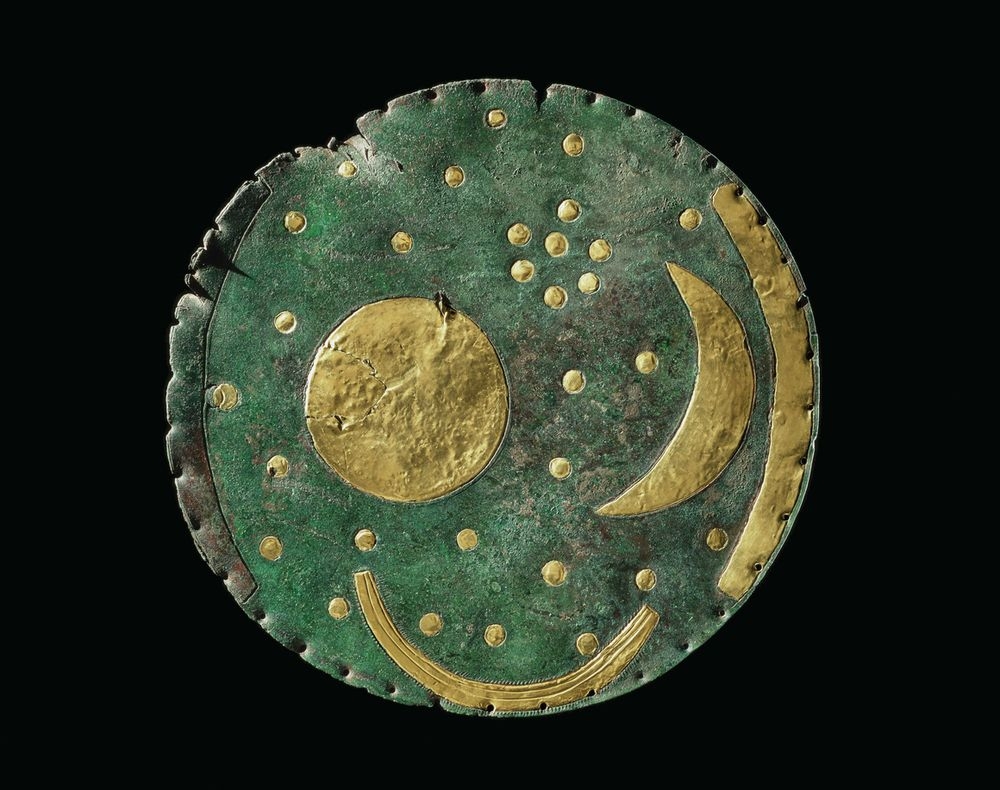
Imagine discovering a bronze disc buried on a hilltop nearly four thousand years after it was made. Its surface is covered with gold symbols representing the Sun or Moon, a crescent, and a cluster of stars. At first glance, it appears decorative. Closer examination, however, reveals something far more remarkable: the arrangement of these symbols corresponds to real astronomical observations.
Today, the Nebra Sky Disc is widely regarded as the oldest known concrete depiction of the night sky. Created during the Early Bronze Age, it demonstrates that people living in Central Europe possessed a sophisticated understanding of celestial cycles centuries before classical Greek astronomy emerged.
Unlike many archaeological discoveries, the importance of the Nebra Sky Disc does not lie in speculation or mystery alone. Its greatest significance comes from the evidence it provides about the knowledge, craftsmanship, and scientific observation of Bronze Age societies.
An Extraordinary Discovery with an Unusual Story
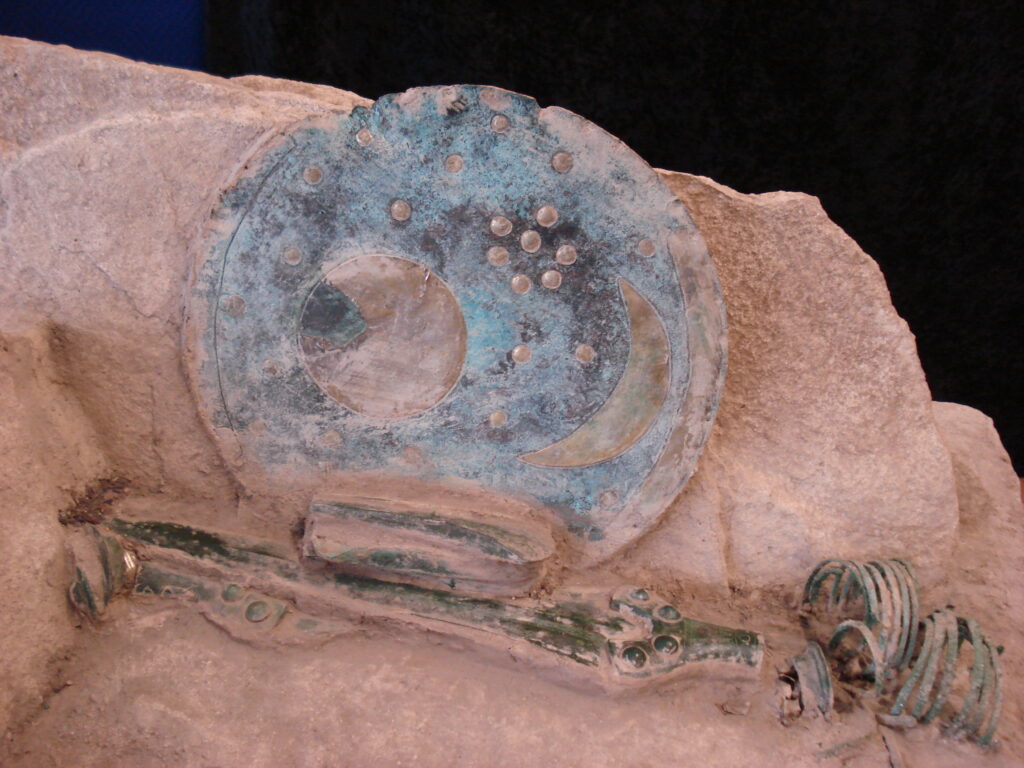
The Nebra Sky Disc was discovered in 1999 on the Mittelberg hill near the town of Nebra in present-day Germany. Unfortunately, it was not uncovered during an archaeological excavation.
Two treasure hunters illegally recovered the disc using metal detectors, damaging both the artifact and the surrounding archaeological site in the process. Shortly afterward, they sold the entire collection on the black market, where it changed hands several times before German authorities recovered it during a police sting operation in Switzerland in 2002.
Although the circumstances of its discovery complicated the archaeological investigation, later excavations at the original site confirmed that the disc genuinely came from Mittelberg. Soil samples, traces of bronze corrosion, and the associated artifacts all supported its authenticity.
The disc had not been buried alone. It was accompanied by two bronze swords, two axes, a chisel, and spiral arm rings, forming a remarkable Bronze Age hoard that helped archaeologists determine its age and cultural context.
What Does the Disc Show?
The Nebra Sky Disc measures approximately 32 centimeters in diameter and weighs just over two kilograms. It consists of a bronze plate decorated with carefully applied gold inlays.
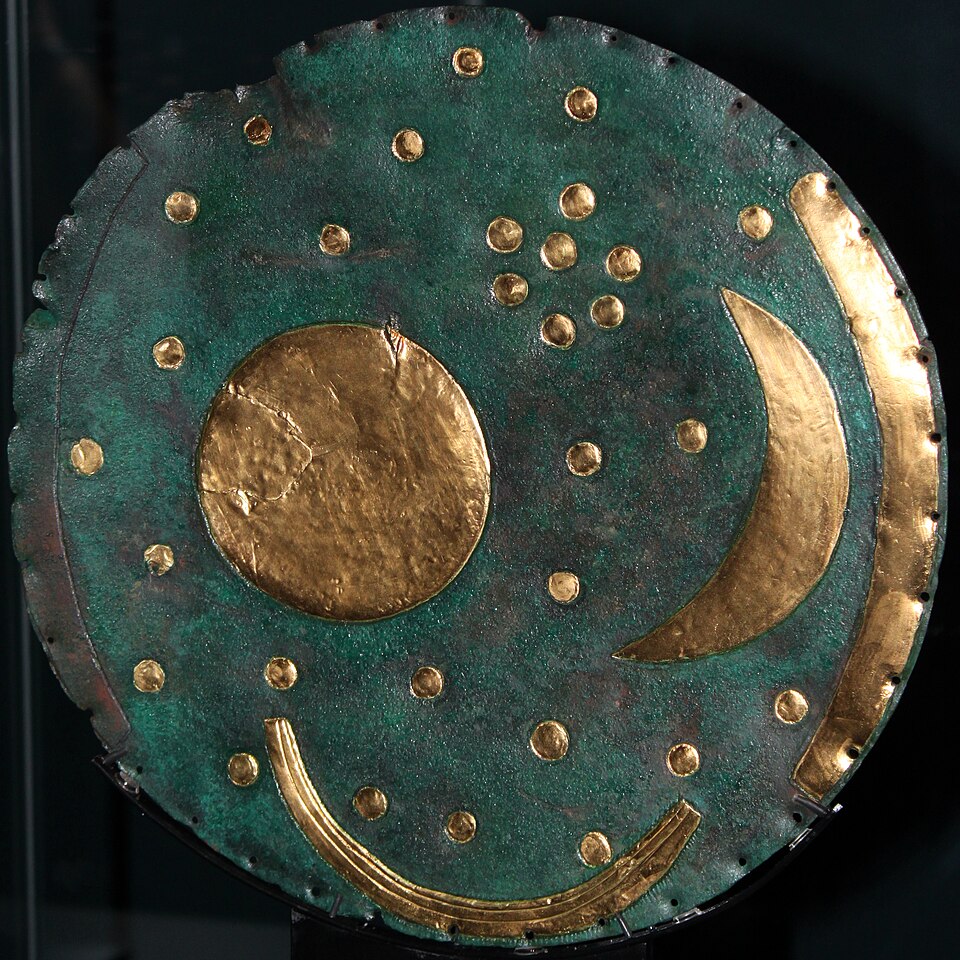
Most researchers interpret the large circular symbol as either the Sun or the full Moon, while the crescent clearly represents a waxing Moon. Thirty-two smaller gold circles represent stars, including a distinctive cluster of seven that is almost universally identified as the Pleiades.
The Pleiades played an important role in many ancient cultures because their appearance and disappearance in the night sky helped mark seasonal changes. For agricultural societies, these observations could determine the best time for planting and harvesting.
The disc did not remain unchanged throughout its lifetime. Detailed analysis has shown that the gold decorations were added in several stages. Side arcs were attached after the original design, and a curved element near the bottom—often interpreted as a solar boat—was incorporated later still. Finally, small holes were punched around the edge, suggesting that the disc may once have been mounted onto another object or displayed during ceremonies.
Rather than representing a single artistic creation, the Nebra Sky Disc appears to have evolved over generations, reflecting changing ideas and possibly changing functions.
A Bronze Age Guide to the Sky?
One of the most convincing interpretations suggests that the disc functioned as a practical astronomical instrument.
The two golden arcs added to the sides span an angle of approximately 82 degrees, corresponding closely to the difference between the positions of sunrise and sunset at the summer and winter solstices at the latitude where the disc was discovered.
This relationship is unlikely to be accidental. If the disc was aligned correctly, it could have helped observers identify important points in the solar year. Such knowledge would have been valuable for agricultural communities whose survival depended on understanding seasonal cycles.
Some researchers also argue that the combination of the Pleiades and the lunar symbols may have helped reconcile lunar months with the solar year. Because twelve lunar months are approximately eleven days shorter than one solar year, ancient societies often needed methods to determine when an additional month should be inserted into their calendars.
The Nebra Sky Disc may have served as a visual reminder of these astronomical relationships rather than as a measuring instrument in the modern sense.
This interpretation explains why the object combines symbolic imagery with surprisingly accurate astronomical observations.
Mittelberg (Discovery Site)

Science, Symbolism, or Both?
Although the astronomical interpretation is widely accepted, an important question remains.
Was the Nebra Sky Disc actually used to observe the sky, or did it simply represent astronomical knowledge that already existed?
The distinction matters because archaeological objects often served several purposes at once. A modern globe, for example, can function as a teaching tool, a decorative object, or a symbol of scientific knowledge. The Nebra Sky Disc may have occupied a similarly complex role within Bronze Age society.
Its careful craftsmanship certainly suggests that it was more than an everyday instrument. The bronze surface was deliberately shaped, polished, and decorated with gold, materials that were both valuable and technically demanding to work with. Producing such an object required skilled metalworkers and access to long-distance trade networks that supplied copper, tin, and gold from different parts of Europe.
Some archaeologists therefore believe the disc belonged to an elite individual, perhaps someone whose authority was closely connected to knowledge of the heavens. In many ancient societies, understanding the movement of the Sun, Moon, and stars carried practical importance for agriculture while also playing a central role in religion and political power.
If this interpretation is correct, the Nebra Sky Disc may have functioned both as a record of astronomical observations and as a ceremonial object that demonstrated the status of its owner.
These possibilities are not mutually exclusive. An object can represent scientific knowledge while simultaneously serving religious or symbolic purposes, particularly in cultures where astronomy, ritual, and seasonal life were closely connected.
Why the Nebra Sky Disc Changed Our Understanding of Bronze Age Europe
Before the discovery of the Nebra Sky Disc, historians generally assumed that the most advanced astronomical knowledge of the Bronze Age developed primarily in civilizations such as Egypt and Mesopotamia.
The discovery at Mittelberg encouraged researchers to reconsider that assumption.
The disc demonstrates that communities living in Central Europe around 1600 BC possessed not only exceptional metalworking skills but also a sophisticated understanding of celestial cycles. Whether this knowledge developed locally, arrived through long-distance cultural exchange, or combined influences from several regions remains an active area of research.
The materials themselves tell a similar story. Scientific analysis has shown that the copper originated in the Austrian Alps, while much of the gold appears to have come from Cornwall in southwestern Britain. These findings suggest that Bronze Age Europe was connected by extensive trade networks capable of moving valuable materials across remarkable distances.
The Nebra Sky Disc therefore represents more than a single archaeological discovery. It provides evidence that ideas, technologies, and materials travelled between distant communities long before written history documented such exchanges.
Rather than depicting isolated societies, the archaeological record increasingly reveals a Europe connected through trade, craftsmanship, and the exchange of knowledge.
Theories and Speculation
Because the Nebra Sky Disc appears unusually sophisticated, it has inevitably attracted speculative interpretations.
Some authors have described it as evidence of forgotten civilizations or knowledge far beyond what Bronze Age people could have possessed. Others have suggested that it records astronomical events impossible to observe without advanced instruments.
These ideas have received considerable public attention but find little support within archaeological research.
The astronomical features visible on the disc can all be explained through careful naked-eye observation carried out over many generations. Ancient people did not require telescopes to identify the Pleiades, observe the changing position of sunrise throughout the year, or recognize the repeating cycles of the Moon.
The true achievement of the Nebra Sky Disc is therefore not that it contains impossible knowledge, but that it preserves genuine astronomical understanding in a form that has survived for nearly four thousand years.
Its significance comes from what it tells us about Bronze Age societies rather than from theories that extend beyond the available evidence.
What the Nebra Sky Disc Really Tells Us
The Nebra Sky Disc reminds us that scientific knowledge did not suddenly appear with the civilizations of classical Greece or the invention of written astronomy.
Long before mathematical models described the movement of planets, people carefully observed the sky, recognized repeating patterns, and developed practical ways of relating those patterns to everyday life.
The communities that created the Nebra Sky Disc depended on seasonal change for farming, travel, and survival. Understanding the movements of the Sun and Moon was therefore not an abstract scientific exercise but a practical necessity.
The disc represents the moment when that accumulated knowledge was transformed into a permanent object.
Whether it was used for teaching, ceremony, observation, or all three, it demonstrates that Bronze Age Europe possessed a far richer intellectual tradition than historians once believed.
Its discovery did not rewrite history. Instead, it expanded it by revealing another chapter in humanity’s long effort to understand the sky.
Common Questions About the Nebra Sky Disc
What is the Nebra Sky Disc?
The Nebra Sky Disc is a Bronze Age bronze disc decorated with gold symbols representing celestial objects. It is widely regarded as the oldest known realistic depiction of the night sky.
How old is the Nebra Sky Disc?
Most researchers date the disc to around 1600 BC, making it approximately 3,600 years old.
What do the symbols on the Nebra Sky Disc represent?
The symbols are generally interpreted as the Sun or full Moon, a crescent Moon, the Pleiades star cluster, horizon arcs marking the solstices, and a later-added solar boat.
Where was the Nebra Sky Disc found?
The disc was discovered on Mittelberg Hill, near the town of Nebra in Saxony-Anhalt, Germany.
Why is the Nebra Sky Disc important?
It provides strong evidence that Bronze Age communities in Central Europe possessed sophisticated astronomical knowledge and maintained long-distance trade and cultural connections centuries before classical antiquity.