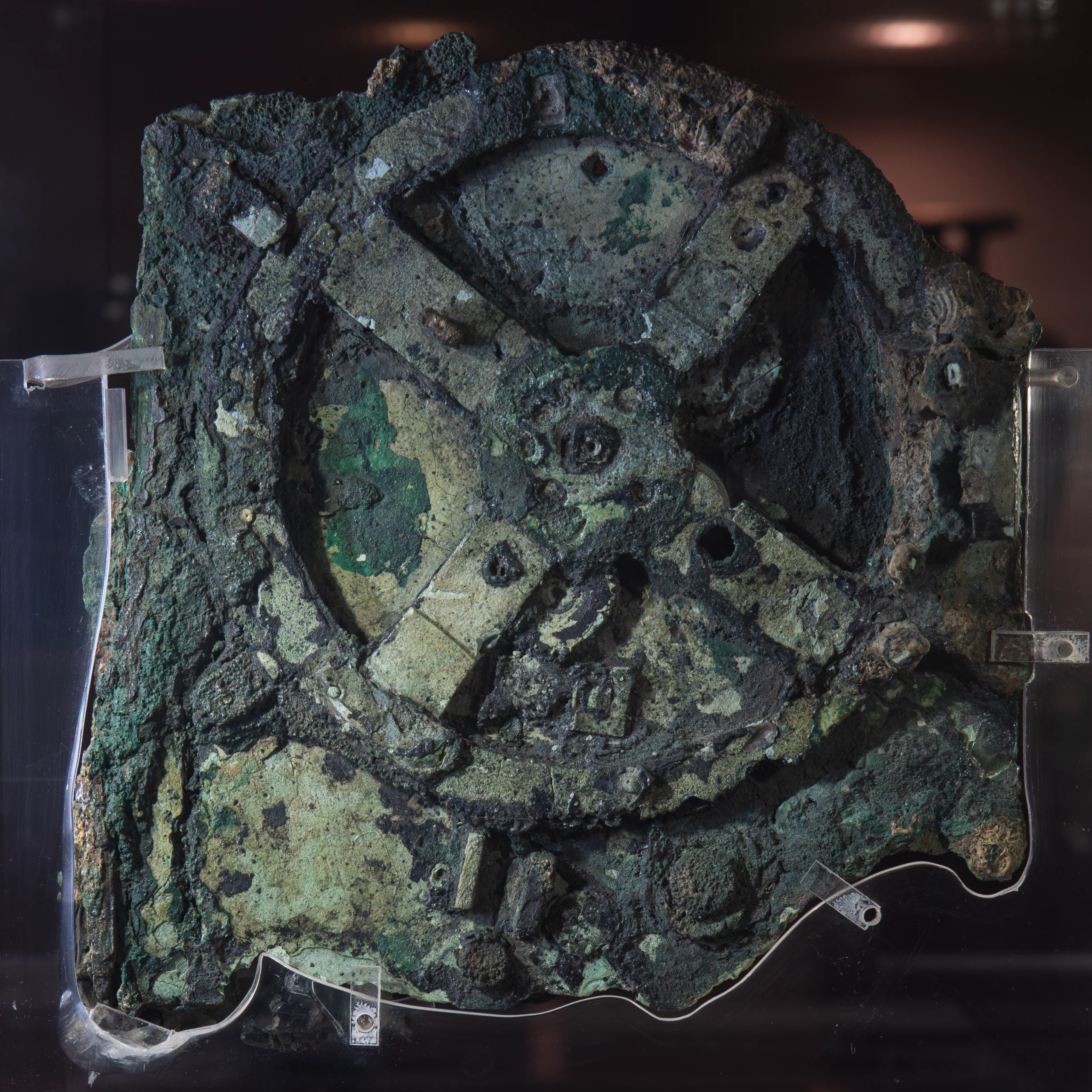
In 1901, sponge divers working near the Greek island of Antikythera discovered the remains of an ancient shipwreck resting on the seabed between Crete and the Peloponnese. The vessel carried a cargo of statues, glassware, jewelry, and other luxury goods, most likely destined for the Roman world. Among the recovered artifacts was a collection of heavily corroded bronze fragments that initially appeared unremarkable.
Only after closer examination did researchers realize that these fragments contained precisely cut gear teeth.
This discovery presented an immediate problem. Ancient civilizations had used gears before, but the surviving examples were generally simple mechanisms designed for specific tasks. The fragments from Antikythera appeared to belong to something far more sophisticated. As additional studies revealed more of the internal structure, it became clear that the object was not a damaged tool or decorative artifact, but part of a complex machine capable of modeling astronomical cycles.
Today, the Antikythera Mechanism is often described as the world’s first known analog computer. While the comparison is modern, it captures the essential idea: the device used a system of gears to perform calculations and display information about the movements of celestial bodies.
The mechanism is remarkable not because it appears impossible, but because it demonstrates a level of mechanical sophistication rarely associated with the ancient world. Understanding why requires looking not only at how the device worked, but also at the scientific tradition that made it possible.
Discovery Beneath the Sea
The shipwreck in which the mechanism was found is generally dated to the first century BC. Archaeologists believe the vessel was transporting valuable goods across the Mediterranean when it sank, probably during a storm.
The first recovery efforts focused on the more obvious treasures. Marble and bronze statues attracted immediate attention, while the corroded bronze fragments that would later become famous remained largely overlooked. Their significance only became apparent when cracks in the corrosion revealed internal gear teeth. Even then, understanding the object proved difficult.
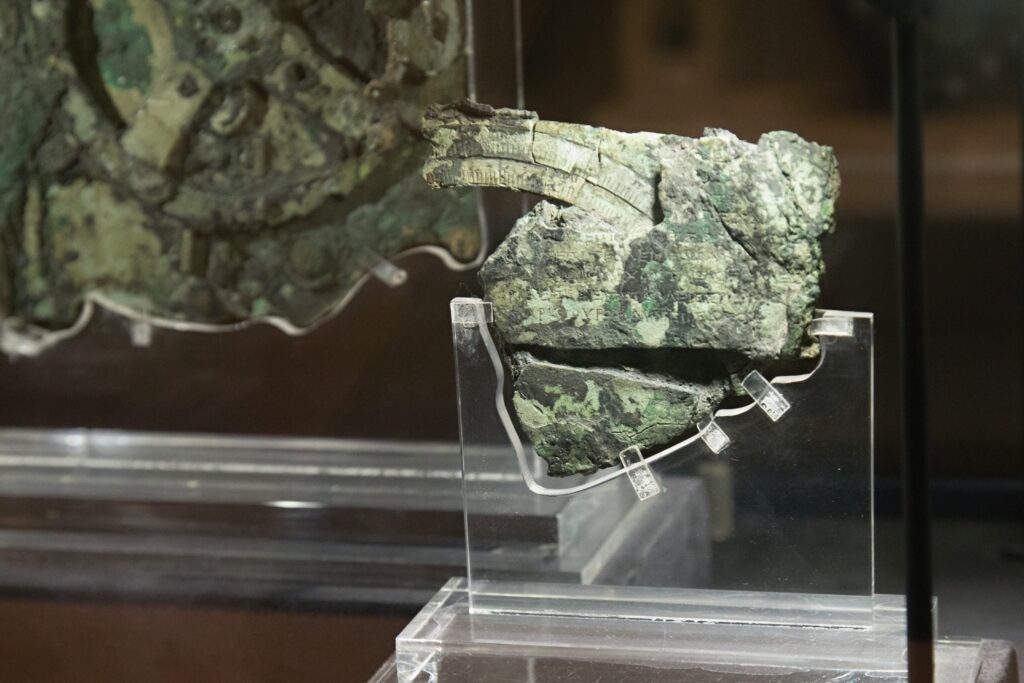
The surviving fragments represented only a portion of the original mechanism. Many components had been damaged or lost, and centuries underwater had fused corrosion products to the remaining surfaces. Researchers could identify gears, but determining their purpose was another matter entirely.
A major breakthrough came during the twentieth century when X-ray imaging allowed investigators to examine structures hidden inside the fragments. Later, high-resolution tomography and three-dimensional scanning revealed details that earlier researchers could not see, including inscriptions, gear trains, and internal arrangements of components.
These studies transformed understanding of the artifact. What initially appeared to be a collection of disconnected fragments emerged as part of a highly organized mechanical system containing more than thirty interlocking gears.
More importantly, the scans showed that the gears had not been arranged randomly. Their sizes and ratios corresponded to known astronomical cycles, indicating that the mechanism had been designed to perform specific calculations related to the movements of the Sun, Moon, and possibly the planets.
A Mechanical Model of the Sky
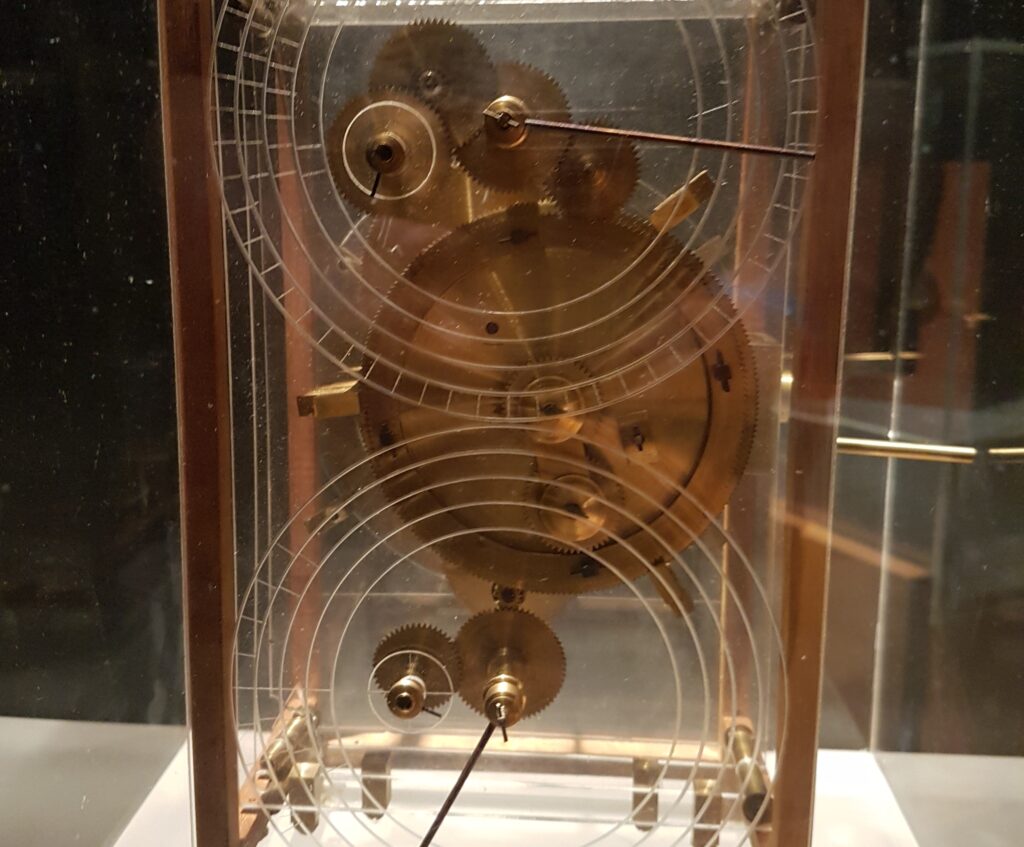
The Antikythera Mechanism was housed inside a wooden case approximately the size of a modern shoebox. A hand crank on the side allowed the user to rotate a series of interconnected gears, causing pointers on several dials to move in carefully calculated ways.
The front display functioned as a model of the sky as understood by Greek astronomers. One pointer represented the Sun, while another tracked the Moon. As the mechanism was turned, these pointers moved around a circular scale that combined calendar information with the zodiac.
At first glance, this might sound similar to a clock. The crucial difference is that the mechanism was not simply measuring time. It was reproducing astronomical relationships mathematically.
Greek astronomers had long recognized that celestial motions followed predictable patterns. Through observation, they had identified cycles governing the movements of the Sun and Moon. The challenge was translating this knowledge into a mechanical form.
The designers of the Antikythera Mechanism accomplished this through gear ratios. By carefully selecting the number of teeth on each gear, they could represent astronomical cycles physically. Turning the crank effectively advanced time, allowing the user to observe how celestial positions would change in the future.
One of the most sophisticated features involved the Moon. Ancient astronomers understood that the Moon does not move across the sky at a perfectly constant speed. Its orbit causes variations that become noticeable over time. The mechanism accounted for this irregular motion through a specialized arrangement of gears that produced variable movement in the lunar pointer.
This feature is particularly significant because it demonstrates that the builders were not merely creating a calendar. They were incorporating astronomical theory into a mechanical system. The machine did not simply record observations; it embodied mathematical models developed through centuries of study.
The Back Dials and the Prediction of Eclipses
While the front display tracked the visible motions of the Sun and Moon, the back of the mechanism contained what may be its most impressive features.
Two large spiral dials occupied much of the rear surface. These displays allowed the user to track long astronomical cycles that would have been difficult to calculate manually.
One of these was the Metonic Cycle, a period of approximately nineteen years after which the phases of the Moon repeat on nearly the same calendar dates. Ancient Greek astronomers used this relationship to reconcile lunar and solar calendars, which rarely align perfectly.
The mechanism represented this cycle mechanically. As the gears turned, a pointer moved through the spiral dial, indicating the current position within the nineteen-year sequence.
A second dial tracked the Saros Cycle, a period of roughly eighteen years, eleven days, and eight hours. This cycle was particularly important because it could be used to predict eclipses.
Ancient observers had long recognized that eclipses follow repeating patterns. By recording observations over many generations, astronomers discovered that similar alignments of the Earth, Moon, and Sun occur at regular intervals. The Saros Cycle was one of the most useful of these patterns.
The Antikythera Mechanism incorporated this knowledge directly into its design. As the user advanced the machine, the eclipse dial indicated when future eclipses were expected to occur and, in some cases, even provided information about their characteristics.
This is one of the reasons the mechanism is often described as a calculating device rather than a simple calendar. It did not merely display dates. It used known astronomical relationships to predict future events.
For a device built more than two thousand years ago, this represents an extraordinary combination of observation, mathematics, and engineering.
A Modern Reconstruction of the Antikythera Mechanism
Who Built It?
One of the most common questions surrounding the Antikythera Mechanism concerns its creator.
Unfortunately, no surviving inscription identifies the individual responsible for its construction. The shipwreck provides evidence for the device itself, but not for the workshop in which it was made. Even so, historians have been able to place it within a broader intellectual tradition.
The mechanism was almost certainly created during the Hellenistic period, an era that followed the conquests of Alexander the Great and saw the emergence of major centers of learning throughout the eastern Mediterranean. Cities such as Alexandria, Pergamon, and Rhodes became hubs of scientific and mathematical research.
Several clues point toward Rhodes as a particularly strong candidate. The island was renowned for its astronomical schools, and ancient sources associate it with scholars who studied celestial motions in great detail.
One of these scholars was Hipparchus, often regarded as one of the greatest astronomers of antiquity. Although there is no evidence that he built the mechanism himself, some of the astronomical models represented within the device are closely related to ideas associated with his work.
Archimedes is another figure frequently mentioned in discussions of the mechanism. Ancient writers describe complex mechanical devices created by Archimedes, including astronomical instruments capable of representing celestial movements. However, he lived earlier than the likely construction date of the Antikythera Mechanism and cannot be considered its direct creator.
The most reasonable conclusion is that the mechanism emerged from a community of highly skilled engineers, craftsmen, and astronomers rather than from a single isolated genius.
Like many technological achievements, it was probably the result of accumulated knowledge rather than a sudden breakthrough.
Why Don’t We Have More Machines Like It?
Perhaps the most intriguing question raised by the Antikythera Mechanism is not how it worked, but why it appears to be alone.
Technologies of this complexity rarely emerge without predecessors. A machine containing dozens of precisely manufactured gears is unlikely to represent the first attempt at such engineering. Its existence implies earlier experimentation, established techniques, and craftsmen capable of producing intricate mechanical components.
If that is true, where are the other machines?
Part of the answer may lie in the materials themselves. Bronze was valuable throughout the ancient world. Unlike stone monuments, metal objects were often recycled. A damaged mechanism could be melted down and transformed into tools, weapons, or other useful items. Over centuries, countless objects may have disappeared in this way.
The survival of the Antikythera Mechanism may be largely accidental. The shipwreck protected it from recycling by placing it beyond human reach for nearly two thousand years.
Preservation presents another challenge. Many ancient devices likely incorporated wood, leather, and other organic materials that deteriorate rapidly. Even when metal components survive, the structures surrounding them often vanish completely.
The result is a historical record that favors durable materials while obscuring many aspects of ancient technology.
Rather than representing a unique invention, the Antikythera Mechanism may be the only surviving example of a broader tradition that has otherwise been lost.
This possibility is perhaps more interesting than the idea of a single extraordinary machine. It suggests that ancient engineering may have been more advanced and more widespread than the surviving evidence alone would indicate.
Location of Antikythera

Theories and Speculation
Because the mechanism appears so advanced, it has inevitably attracted more speculative interpretations.
Some writers have suggested that it represents knowledge inherited from a lost civilization. Others have connected it to myths such as Atlantis or proposed that it demonstrates technological capabilities that conventional history cannot explain.
These theories tend to focus on a genuine observation: the mechanism is surprisingly sophisticated. What they often overlook is that sophistication alone is not evidence of an unknown source.
The device fits comfortably within what is known about Hellenistic science. Ancient Greek scholars developed advanced mathematical models, conducted astronomical observations, and experimented with mechanical systems long before the mechanism was constructed.
The challenge is not explaining how such a machine could exist. The challenge is explaining why so little of the surrounding technological tradition has survived.
In this sense, the Antikythera Mechanism remains remarkable without requiring extraordinary explanations.
What the Mechanism Really Tells Us
The Antikythera Mechanism does not prove that ancient people possessed impossible technology, nor does it overturn our understanding of history.
What it demonstrates is that the ancient world was capable of producing scientific instruments of remarkable sophistication when knowledge, craftsmanship, and resources were brought together.
Its gears encode astronomical cycles that required centuries of observation to understand. Its construction demanded technical skills that few craftsmen could have possessed. Its design reflects a culture that valued mathematical explanations of natural phenomena and sought ways to represent them physically.
Perhaps the most important lesson is that history is not always a story of continuous progress. Knowledge can be preserved, expanded, forgotten, and rediscovered. Libraries burn, workshops disappear, and traditions fade. When that happens, entire chapters of technological development can vanish from the historical record.
The Antikythera Mechanism survives because a single ship sank at the right place and remained hidden for centuries. Had that vessel completed its journey, the device might have been recycled, destroyed, or lost without a trace.
If that had happened, our understanding of ancient technology would look very different today.
Rather than rewriting history, the mechanism reminds us that our picture of the past is often incomplete. Every so often, archaeology uncovers an object that forces us to expand that picture, and few discoveries have done so more effectively than the machine recovered from the seabed near Antikythera.
Common Questions About the Antikythera Mechanism
What is the Antikythera Mechanism?
The Antikythera Mechanism is an ancient Greek device discovered in a shipwreck near the island of Antikythera. It is often described as the world’s first known analog computer.
How old is the Antikythera Mechanism?
The device was built around the 2nd century BC and is more than 2,000 years old.
What did the Antikythera Mechanism do?
It modeled the movements of celestial bodies, tracked calendar cycles, and predicted eclipses using a system of interconnected gears.
Who built the Antikythera Mechanism?
The exact creator is unknown, but most researchers believe it was produced by highly skilled Greek engineers connected to the scientific traditions of the Hellenistic world.
Why is the Antikythera Mechanism important?
It demonstrates that ancient Greek astronomy and engineering were significantly more sophisticated than historians once believed and provides rare evidence of advanced mechanical technology in the ancient world.