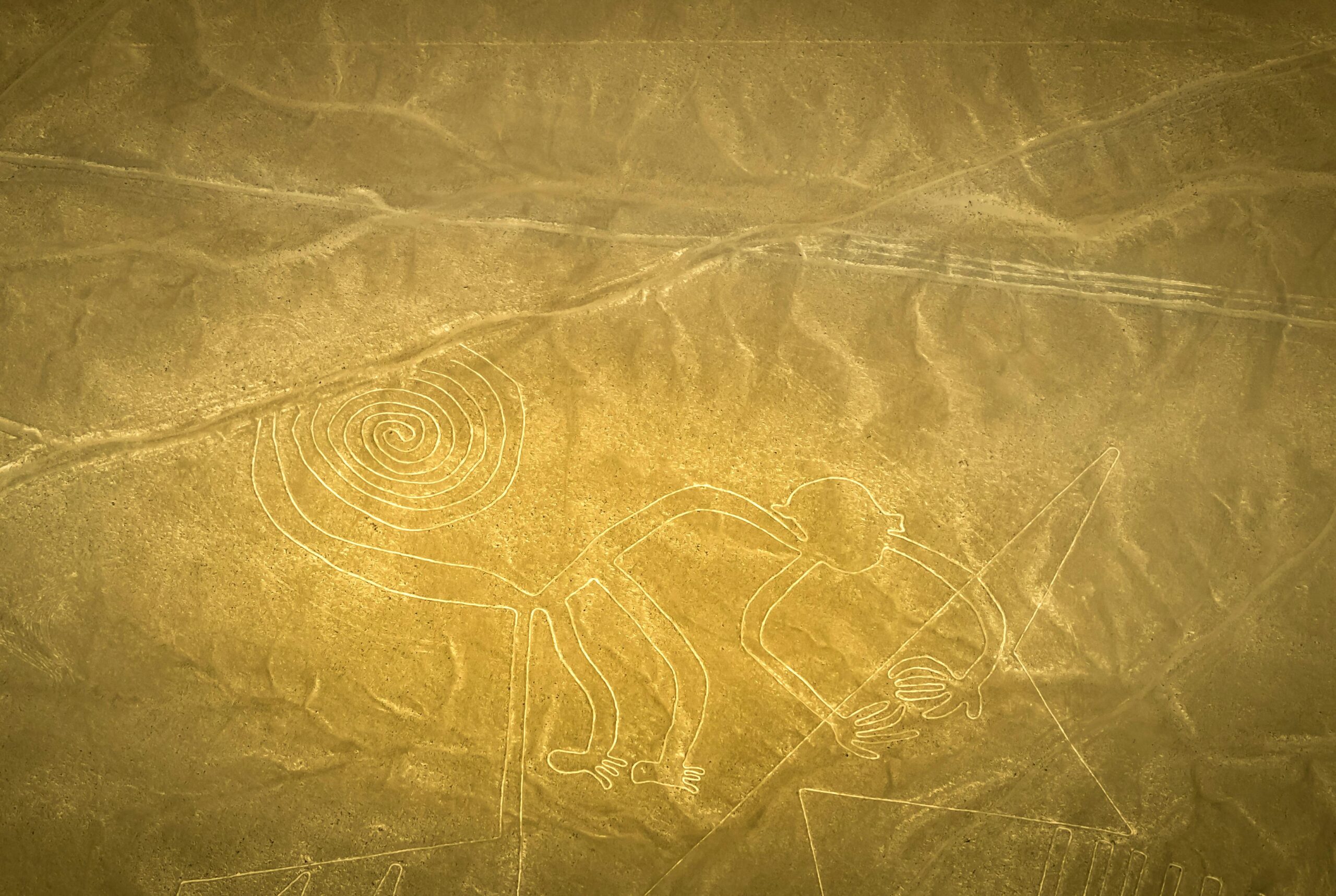
From high above the desert of southern Peru, enormous shapes emerge from the earth — lines stretching for kilometers, perfectly straight, and figures so large they only make sense from the sky. On the ground, they are almost invisible. From above, they form one of the most puzzling creations of the ancient world.
For decades, the Nazca Lines have raised a simple question that still doesn’t have a clear answer: why were they made?
A Landscape of Lines and Figures
The Nazca Lines cover an area of roughly 450 square kilometers. Some of the lines run perfectly straight for kilometers, while others form shapes — monkeys, hummingbirds, spiders — drawn with a surprising sense of proportion.
They were created by removing the top layer of dark stones, exposing the lighter ground beneath. This simple technique, combined with the dry and windless climate, has preserved them for over 2,000 years.

Visible Only From Above
One of the most puzzling aspects of the Nazca Lines is their scale. Many of the figures are so large that they cannot be recognized from the ground.
This has led to the assumption that the creators must have had some way of viewing them from above — an idea that has inspired more speculative theories over time.
However, experiments have shown that simple tools, stakes, and basic geometry would have been enough to create the shapes with surprising accuracy.
Where the Nazca Lines are located

How Were They Made?
Despite their size, the lines themselves are not complex in technique. The Nazca people likely used ropes, wooden stakes, and careful planning to map out the designs before removing the surface stones.
What remains difficult to explain is not the method, but the effort. Creating and maintaining these lines would have required coordination, time, and a shared purpose.

Between Ritual and Interpretation
Most archaeologists believe the Nazca Lines had a ceremonial or religious function. Some theories suggest they were connected to water rituals, as water was a critical resource in the desert environment.
Others propose that the lines were part of processions — paths that people walked during rituals, rather than images meant only to be seen.
The shapes themselves may have held symbolic meaning, though much of that meaning has been lost over time.
Theories Beyond Archaeology
The scale and visibility of the lines have led to more unusual interpretations. Some claim the Nazca Lines were signals to the sky, or even evidence of contact with non-human intelligence.
While these ideas are popular, they are not supported by archaeological evidence. The lines can be explained within the context of known human capabilities, even if their exact purpose remains unclear.
A Mystery That Remains Open
Unlike many ancient structures, the Nazca Lines do not offer a clear function. They are not buildings, not defensive structures, not settlements.
They exist as marks on the landscape — deliberate, large-scale, and still not fully understood.
What they represent may never be completely known. But their presence suggests that ancient societies were capable of creating meaning on a scale that we are still trying to interpret.
Common Questions About the Nazca Lines
What are the Nazca Lines?
The Nazca Lines are large geoglyphs etched into the desert of southern Peru, forming shapes and figures that are best seen from above.
How were the Nazca Lines made?
They were created by removing the top layer of dark stones to reveal lighter soil underneath, forming visible patterns.
Why were the Nazca Lines created?
Their purpose is still debated, with theories ranging from ritual pathways to astronomical or symbolic meanings.