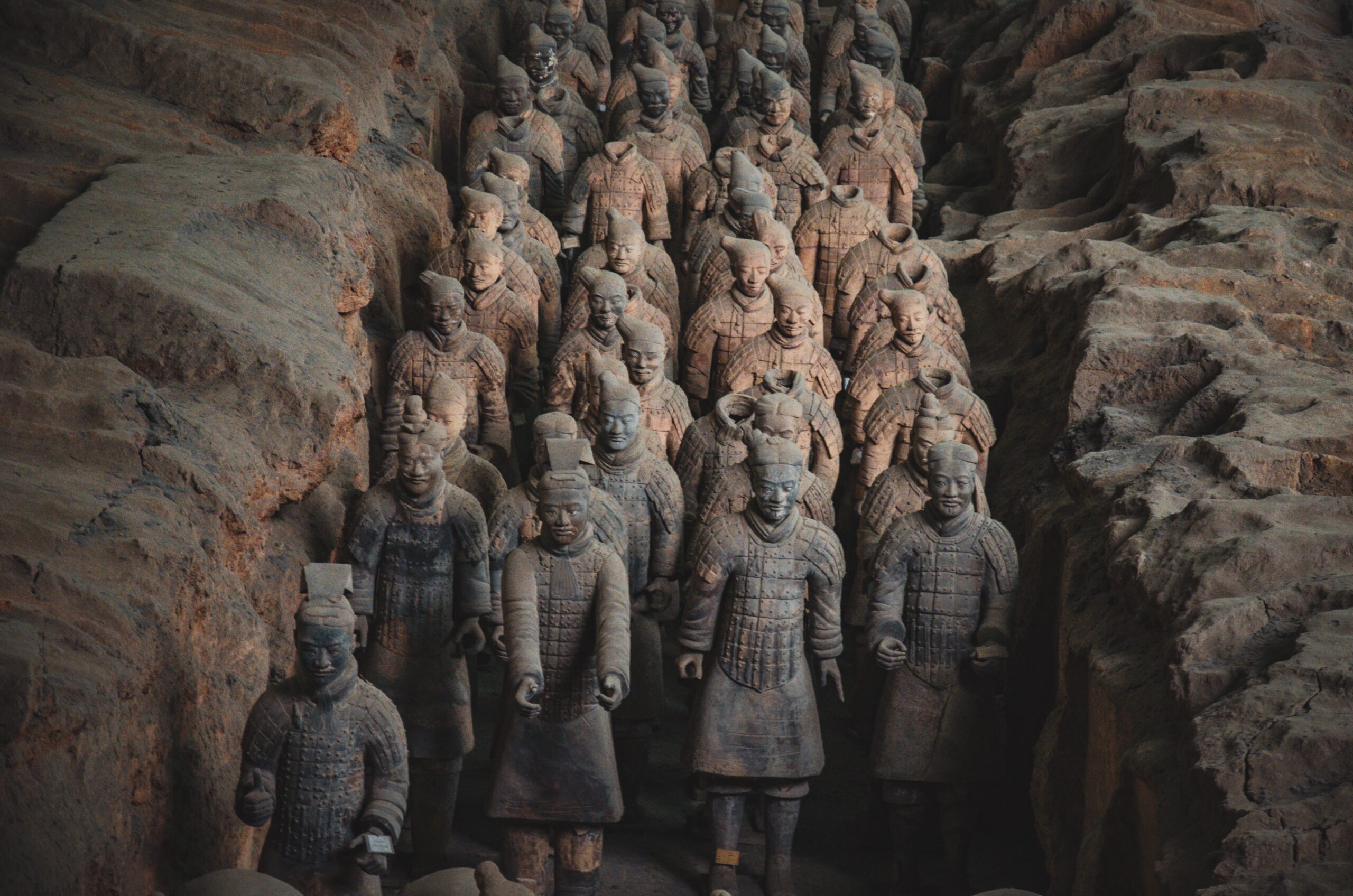
Few archaeological discoveries have captured the world’s imagination quite like China’s Terracotta Army. Hidden beneath the ground for more than two thousand years, thousands of life-sized clay soldiers stood silently guarding the tomb of China’s first emperor until their accidental discovery in 1974.
Each warrior appears remarkably individual. Their facial features, hairstyles, armor, and expressions differ from one another, creating the impression of a real army frozen in time. Alongside infantry, archaeologists uncovered cavalry, archers, officers, generals, horses, bronze weapons, and elaborate military formations designed to protect the emperor in the afterlife.
The Terracotta Army is far more than an artistic achievement. It offers an extraordinary window into the military organization, technology, political ambitions, and beliefs of the Qin Dynasty, the state that first unified China in 221 BC under Emperor Qin Shi Huang.
Yet despite decades of excavation, one of the site’s greatest mysteries remains untouched. At the center of the vast burial complex lies the emperor’s main tomb, a chamber that archaeologists have deliberately chosen not to open. Ancient historical accounts describe rivers of mercury, magnificent palaces, and ingenious mechanical traps, but whether these descriptions are accurate remains unknown.
Today, the Terracotta Army stands as one of the greatest archaeological discoveries ever made, combining historical certainty with enduring mystery.
Mausoleum of Qin Shi Huang
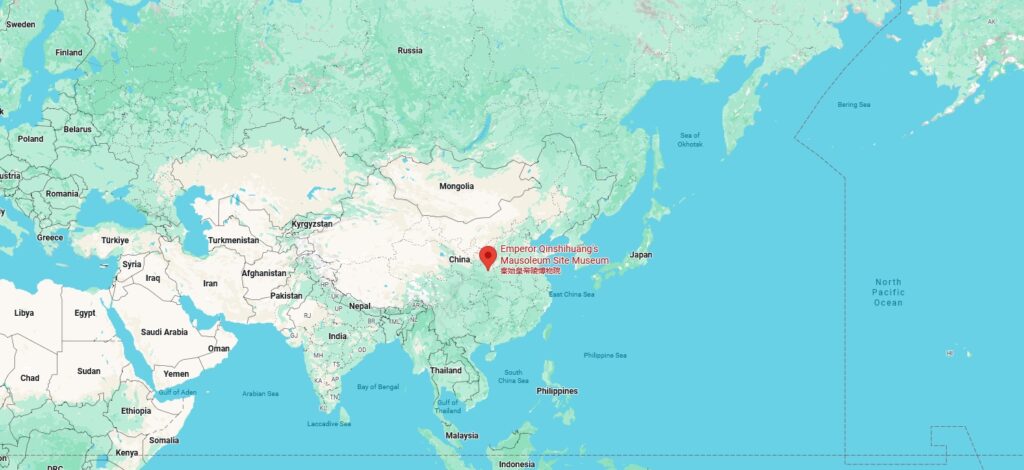
Who Was Qin Shi Huang?
Before China became a unified empire, the region was divided among several rival kingdoms during a turbulent period known as the Warring States era. For more than two centuries, these states competed for territory, resources, and political dominance through nearly constant warfare.
The Kingdom of Qin gradually emerged as the strongest power. Its military reforms, centralized administration, and efficient bureaucracy allowed it to defeat its rivals one by one. In 221 BC, King Ying Zheng completed the conquest of the remaining states and declared himself Qin Shi Huang, meaning “First Emperor of Qin.”
His achievement transformed Chinese history. Rather than ruling a collection of independent kingdoms, Qin Shi Huang established the first centralized Chinese Empire.
His government introduced sweeping reforms, including standardized weights and measures, a unified writing system, a common currency, and an extensive network of roads connecting the empire. Many defensive walls built by earlier states were also linked together, creating the earliest foundations of what would later become the Great Wall of China.
These reforms strengthened imperial control and laid the groundwork for later Chinese dynasties. At the same time, Qin Shi Huang ruled with exceptional authority. Historical sources describe strict legal codes, harsh punishments, forced labor, and large-scale construction projects that required hundreds of thousands of workers.
Although his dynasty lasted only fifteen years after the empire’s unification, its political model profoundly influenced Chinese civilization for more than two millennia.
Preparing for Eternity
Like many rulers of the ancient world, Qin Shi Huang believed that death did not mark the end of power. Instead, the afterlife required the same protection, wealth, and authority enjoyed during life.
Construction of his mausoleum reportedly began shortly after he became king of Qin, decades before he unified China. According to the Han Dynasty historian Sima Qian, hundreds of thousands of laborers participated in building the enormous burial complex over nearly forty years.
Rather than constructing a simple tomb, the emperor ordered the creation of an underground empire. Palaces, administrative buildings, stables, workshops, storage areas, ceremonial structures, and military forces were all intended to accompany him into eternity.
The Terracotta Army formed only one component of this vast subterranean world. Archaeologists have since identified numerous additional burial pits containing bronze chariots, musicians, acrobats, officials, and exotic animals, suggesting that the emperor intended to recreate every aspect of his earthly court beneath the ground.
Together, these discoveries reveal not merely an elaborate royal burial but one of the most ambitious funerary projects ever undertaken by any ancient civilization.
Discovery in 1974
For more than two thousand years, the Terracotta Army remained completely hidden beneath layers of farmland. Although local legends spoke of an ancient imperial tomb near Mount Li, few imagined the scale of what lay underground.
Everything changed in the spring of 1974 when several farmers digging a well near the village of Xiyang unexpectedly struck fragments of life-sized clay figures instead of water. At first, they believed they had uncovered ordinary pottery, but local archaeologists quickly recognized that the discovery was far more significant.
Subsequent excavations revealed the first of several enormous underground chambers filled with rows of clay soldiers arranged in carefully organized military formations. What initially appeared to be an isolated burial soon proved to be part of a vast mausoleum complex unlike anything previously discovered in China.
The excavation became one of the largest archaeological projects in modern history. Decades later, archaeologists continue to investigate new sections of the site, and only a fraction of the entire mausoleum complex has been explored.
In 1987, UNESCO designated the Mausoleum of the First Qin Emperor as a World Heritage Site, recognizing it as one of humanity’s most extraordinary archaeological treasures.
Three Main Excavation Pits
The Terracotta Army is divided into several large excavation pits, each serving a different military purpose. Together, they recreate the organization of a real Qin army rather than simply displaying rows of identical statues.
Pit 1: The Main Battle Formation
Pit 1 is by far the largest and most impressive. Covering approximately 14,000 square meters (150,000 square feet), it contains long corridors lined with thousands of infantry soldiers standing shoulder to shoulder.
The warriors face east, the direction from which the Qin state had conquered its rivals during the Warring States period. Historians believe this orientation was intentional, symbolically protecting the emperor against any enemies that might threaten him in the afterlife.
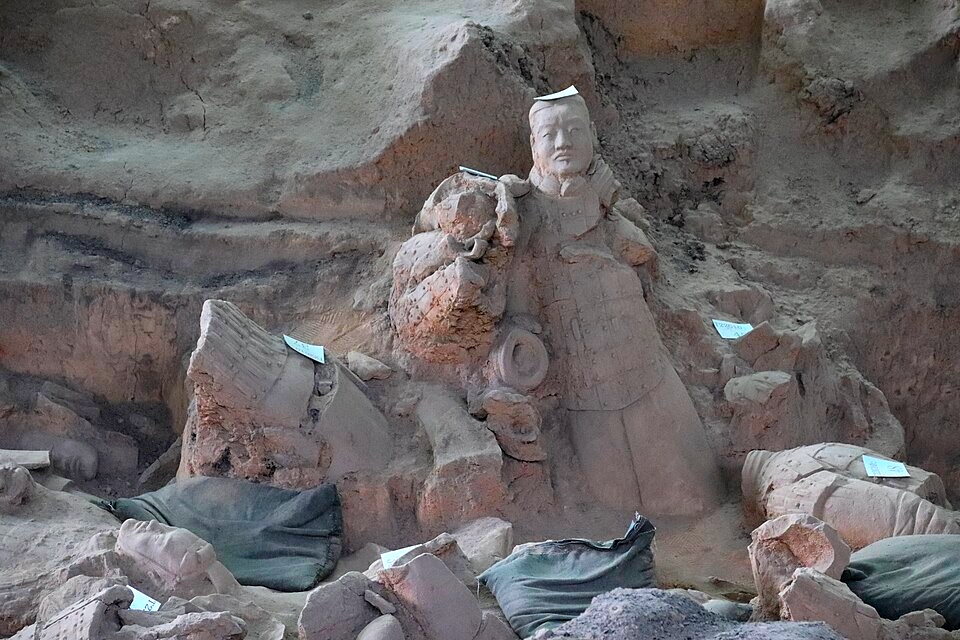
The formation includes front-line soldiers, armored infantry, and supporting units arranged according to Qin military doctrine. Wooden roofs once covered the chamber, although these collapsed over time, crushing many of the figures beneath them.
Today, visitors can still see ongoing restoration work, as broken statues are carefully reconstructed from hundreds of individual fragments.
Pit 2: Specialized Military Units
Discovered a few years after Pit 1, Pit 2 presents a more complex picture of the emperor’s underground army.
Here archaeologists uncovered kneeling and standing archers, cavalry units, horse-drawn chariots, and mixed combat formations designed to support the main infantry force.
Many experts consider Pit 2 especially valuable because several warriors were found largely intact, preserving details of their armor, clothing, and military equipment.
The arrangement demonstrates that the creators of the mausoleum understood battlefield tactics in remarkable detail. Rather than creating decorative statues, they reproduced a realistic military organization based on the Qin Empire’s actual armies.
Pit 3: The Command Headquarters
Although much smaller than the first two pits, Pit 3 is often interpreted as the command center of the underground army.
The chamber contains high-ranking officers, ceremonial equipment, and a war chariot believed to represent military leadership rather than active combat.
Unlike the densely packed formations of Pit 1, the figures here appear arranged for planning and command, suggesting that the emperor intended his afterlife army to function as a complete military organization with its own chain of command.
How Were Thousands of Warriors Made?
One of the most remarkable aspects of the Terracotta Army is its extraordinary realism.
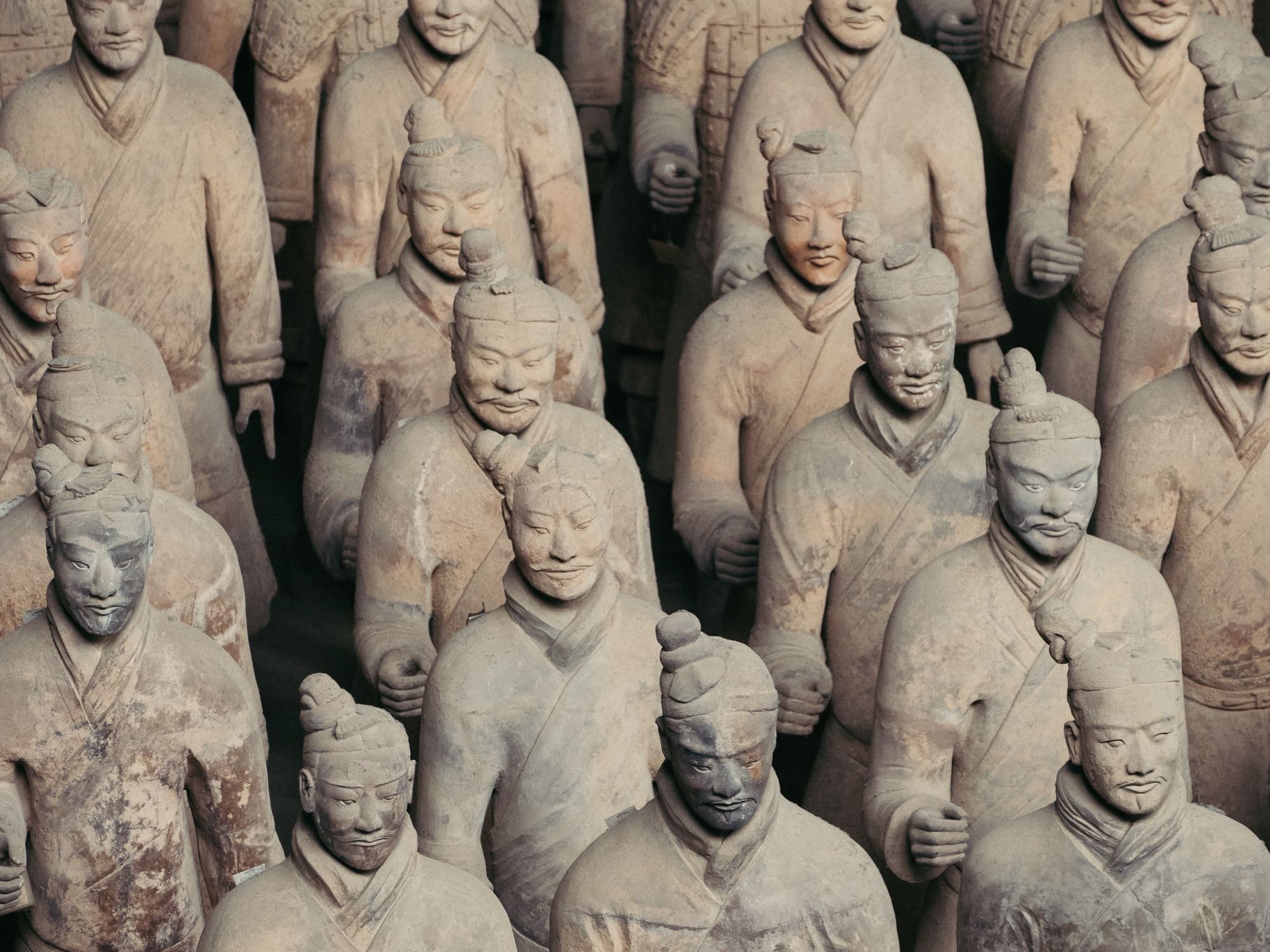
At first glance, every soldier appears completely unique. Different facial expressions, hairstyles, beards, armor styles, and postures give the impression that thousands of individual portraits were sculpted from life.
Modern archaeological research, however, has revealed a highly efficient production system that combined mass manufacturing with individual craftsmanship.
The bodies, legs, arms, and heads were produced separately using standardized molds. Craftsmen then assembled these components before sculptors added fine details by hand. Facial features, ears, hairstyles, mustaches, and armor decorations were individually modified, ensuring that no two finished warriors looked exactly alike.
This combination of standardized production and artistic finishing allowed thousands of statues to be created while maintaining an astonishing level of variety.
The process resembles a sophisticated assembly line more than two thousand years before the Industrial Revolution.
More Than Soldiers
The Terracotta Army includes far more than ordinary infantry. Archaeologists have identified:
- generals
- officers
- cavalrymen
- archers
- crossbowmen
- charioteers
- armored horses
- bronze chariots
Each rank can be recognized by differences in clothing, armor, headgear, posture, and hairstyle. Generals, for example, wear elaborate ceremonial armor and distinctive hats, while kneeling archers are shown in realistic firing positions designed for combat.
These differences reflect the highly organized military hierarchy of the Qin Empire and provide historians with valuable evidence about its armed forces.
Weapons, Paint, and Lost Colors
Visitors today often imagine the Terracotta Army as rows of gray clay figures. In reality, the soldiers originally appeared dramatically different.
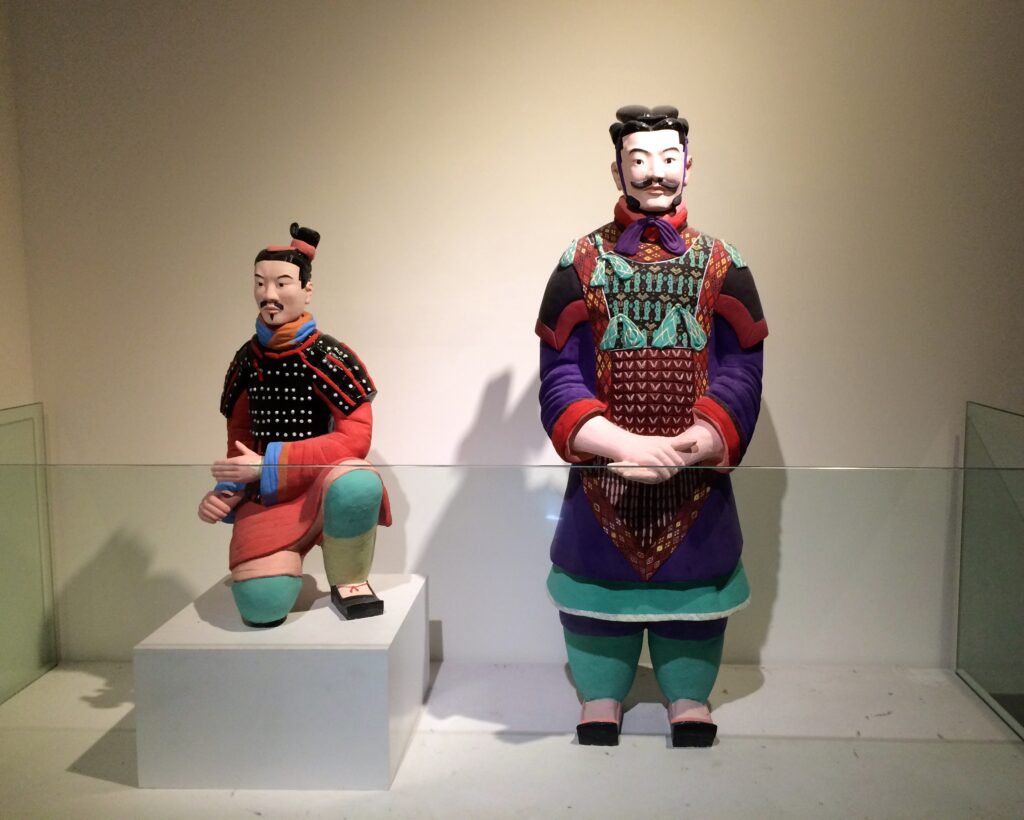
After firing, each statue was coated with layers of lacquer and brightly painted using vivid mineral pigments. Reds, blues, greens, purples, pinks, whites, and blacks gave the warriors remarkably lifelike appearances.
Armor was richly decorated, clothing displayed intricate patterns, and even facial details such as eyebrows and lips were carefully painted.
Unfortunately, exposure to air caused most of these colors to disappear within hours of excavation. The ancient lacquer rapidly dried, cracked, and peeled away, taking the pigments with it.
This unexpected problem forced archaeologists to slow future excavations while conservation scientists developed methods for preserving surviving traces of paint before exposing additional figures.
The army was also equipped with genuine bronze weapons rather than clay replicas. Excavations uncovered thousands of swords, spears, lances, dagger-axes, arrowheads, and crossbow triggers.
Many of these weapons remain remarkably well preserved. Researchers believe that advanced bronze alloys and naturally protective chemical compounds helped prevent corrosion over more than two millennia.
Together, the colorful statues and real military equipment demonstrate that the Terracotta Army was intended not merely as symbolic decoration but as a fully equipped imperial force prepared to defend the emperor for eternity.
The Emperor’s Tomb: Why Has It Never Been Opened?
At the heart of the mausoleum complex lies its greatest mystery: the tomb of Qin Shi Huang himself.
Unlike the surrounding burial pits, the emperor’s central burial chamber has never been excavated. Beneath a large artificial burial mound, archaeologists believe the tomb has remained sealed since the emperor’s burial in 210 BC.
This decision often surprises visitors. With modern technology capable of exploring ancient monuments in unprecedented detail, why has one of history’s most famous tombs remained untouched?
The answer lies in preservation rather than secrecy. Archaeologists agree that opening the chamber without the ability to preserve everything inside could cause irreversible damage. The experience of the Terracotta Army itself provides a clear warning. When the first warriors were exposed to air in 1974, much of their original painted decoration disappeared within hours because the ancient lacquer rapidly deteriorated.
Researchers fear that murals, textiles, wooden structures, pigments, or other fragile organic materials inside the emperor’s tomb could suffer the same fate if excavation began before suitable conservation techniques are available.
For this reason, modern archaeology increasingly emphasizes protecting cultural heritage for future generations rather than excavating simply because it is technically possible.
The Legend of the Mercury Rivers
Much of what is believed about the emperor’s burial chamber comes from the Records of the Grand Historian (Shiji), written by the Han Dynasty historian Sima Qian approximately a century after Qin Shi Huang’s death.
According to his account, the underground palace contained remarkable features, including:
- miniature palaces representing the empire,
- precious treasures,
- a ceiling decorated to resemble the night sky,
- mechanical crossbows designed to deter tomb robbers,
- rivers and seas made from flowing mercury.
For centuries, these descriptions were dismissed by many scholars as literary exaggeration.
However, modern scientific surveys have produced intriguing evidence. Soil analyses conducted around the burial mound have detected unusually high concentrations of mercury compared with the surrounding landscape. While this does not prove the existence of flowing “rivers of mercury,” it suggests that large quantities of the metal may indeed be present within the mausoleum.
Exactly what lies beneath the burial mound remains unknown, making the emperor’s tomb one of archaeology’s greatest unanswered questions.
Separating Fact from Legend
The Terracotta Army has inspired countless documentaries, novels, films, and online discussions. As a result, it is often surrounded by sensational claims that blur the line between archaeological evidence and popular imagination.
Established Evidence
Archaeologists have confirmed that:
- more than 8,000 clay warriors were created,
- the figures formed part of Qin Shi Huang’s enormous mausoleum complex,
- genuine bronze weapons accompanied many of the statues,
- the warriors were originally painted in bright colors,
- only a small portion of the burial complex has been excavated.
These conclusions are supported by decades of excavation and scientific research.
Historical Accounts
Ancient texts describe the emperor’s burial chamber as an elaborate underground palace complete with celestial decorations, mechanical traps, and rivers of mercury.
Some aspects of these descriptions—particularly the presence of elevated mercury levels—have gained partial scientific support. Others cannot currently be verified because the tomb remains sealed.
Speculative Claims
More extraordinary claims frequently appear online, including suggestions that the mausoleum contains advanced lost technology, supernatural mechanisms, or evidence of civilizations beyond those documented in Chinese history.
At present, no archaeological evidence supports these ideas.
The enduring mystery of the emperor’s tomb is compelling precisely because so much remains unknown—not because unsupported theories provide convincing explanations.
Modern Research
Although the central tomb has not been opened, archaeological work across the mausoleum complex continues to produce new discoveries. Researchers employ a wide range of non-invasive techniques, including:
- ground-penetrating radar,
- satellite imaging,
- magnetometry,
- geochemical soil analysis,
- three-dimensional laser scanning.
These technologies allow scientists to map underground structures without disturbing fragile archaeological remains.
Conservation science has also become a major focus. Specialists continue developing methods to preserve pigments, lacquer, wood, textiles, and other delicate materials that rapidly deteriorate when exposed to oxygen.
Many archaeologists believe that future generations, equipped with even more advanced conservation technologies, will eventually investigate the emperor’s burial chamber under far safer conditions.
Until then, the unopened tomb remains one of the world’s most carefully protected archaeological sites.
Common Questions About the Terracotta Warriors
Archaeologists estimate that the mausoleum originally contained more than 8,000 life-sized soldiers, along with hundreds of horses, chariots, and military officers.
Why was the Terracotta Army built?
Most historians believe Qin Shi Huang commissioned the army to protect him in the afterlife and to symbolize his imperial authority beyond death.
Are all the Terracotta Warriors different?
While many components were produced using standardized molds, artisans individually finished the faces, hairstyles, armor, and other details, making each warrior appear unique.
Were the warriors always gray?
No. They were originally painted in vivid colors, including red, blue, green, purple, black, and white. Most of the paint disappeared shortly after excavation because the ancient lacquer deteriorated when exposed to air.
Has the emperor’s tomb been opened?
No. The central burial chamber of Qin Shi Huang remains sealed. Archaeologists have chosen to preserve the tomb until conservation techniques can better protect its fragile contents.
What is the biggest mystery surrounding the site?
The greatest mystery is the unopened tomb itself. Ancient historical accounts describe an elaborate underground palace containing rivers of mercury and mechanical defenses, but these claims cannot yet be fully verified.