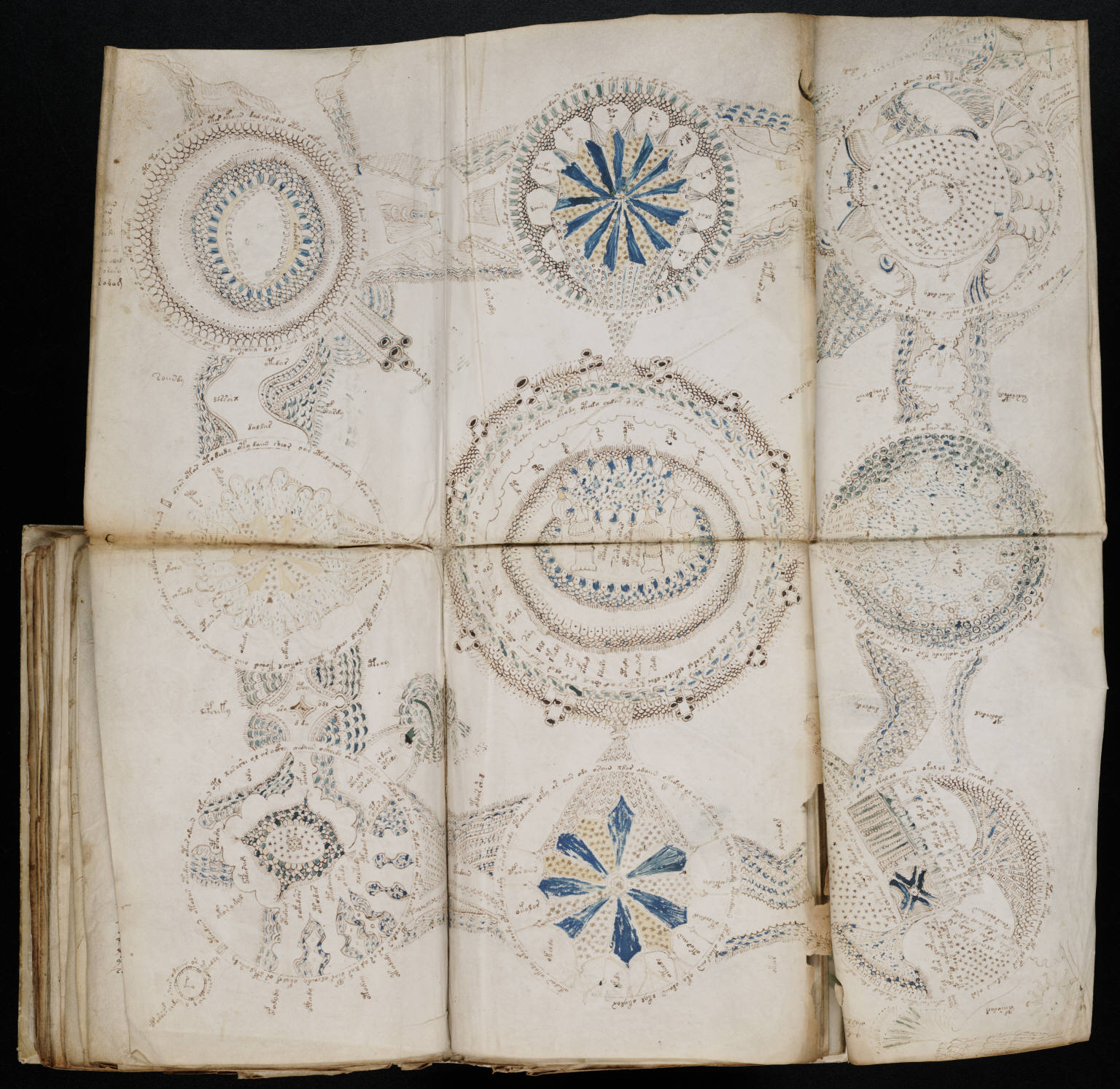
Few medieval books have generated as much curiosity as the Voynich Manuscript. Filled with an unknown writing system, unusual botanical drawings, astronomical diagrams, and illustrations unlike anything found in other medieval manuscripts, it has challenged historians, linguists, cryptographers, and computer scientists for more than a century.
Unlike many historical mysteries that rely on legends or incomplete evidence, the Voynich Manuscript is a real artifact that can be studied firsthand. Every page has been digitized, its parchment has been scientifically dated, and its illustrations have been examined in remarkable detail. Yet despite decades of research, no one has been able to explain what the manuscript says, who wrote it, or why it was created.
Rather than becoming less mysterious as new technologies emerge, the manuscript has continued to resist every serious attempt at interpretation. Modern statistical analysis has shown that the text follows consistent patterns similar to natural language, while radiocarbon dating has confirmed that the manuscript itself was produced during the early fifteenth century. Together, these discoveries have transformed the Voynich Manuscript from a curiosity into one of the most carefully studied unsolved documents in medieval history.
A Book Unlike Any Other
The manuscript owes its modern name to Wilfrid Voynich, a Polish rare book dealer who acquired it in 1912 from the Villa Mondragone near Rome. Since then, it has become one of the world’s most famous undeciphered manuscripts.
Today, it is preserved at Yale University’s Beinecke Rare Book & Manuscript Library, where it is catalogued as MS 408. The library has made the entire manuscript freely available online, allowing researchers and the public alike to examine every surviving page in high resolution.
The manuscript originally contained around 240 parchment pages, although several leaves are now missing. It is written entirely by hand using brown ink, while many pages contain colorful illustrations painted in green, blue, red, yellow, and brown pigments. The unknown script runs consistently from left to right, suggesting that its author followed a structured writing system rather than creating random symbols.
At first glance, the manuscript resembles an ordinary medieval scientific or medical book. However, a closer look reveals that almost nothing inside matches known medieval traditions. Many of the illustrated plants cannot be confidently identified, the diagrams have no clear equivalents in other manuscripts, and the writing system has never been linked to any known language.
For historians, this combination of authentic medieval materials and completely unfamiliar content is what makes the Voynich Manuscript so remarkable.
Scientific Dating Confirmed Its Age
For much of the twentieth century, historians debated whether the Voynich Manuscript might be an elaborate Renaissance forgery. The unusual script and unfamiliar illustrations led some researchers to suspect that it had been created centuries later than claimed, perhaps to deceive collectors or scholars.
This theory changed significantly in 2009, when researchers at the University of Arizona performed radiocarbon dating on the manuscript’s parchment. Four separate samples were analyzed, producing a consistent date range between 1404 and 1438. The results showed that the animal skins used to make the parchment originated during the early fifteenth century.
Additional studies of the manuscript’s pigments and inks have also found that they are generally consistent with materials available during the late medieval period. While this does not prove when every illustration or note was added, it strongly supports the conclusion that the manuscript itself is an authentic medieval document rather than a modern fabrication.
Scientific dating solved one important question—but left the manuscript’s greatest mystery untouched. Knowing when it was created tells us little about who wrote it or what it was intended to communicate.
What Is Inside the Manuscript?
Although the text remains undeciphered, the illustrations allow researchers to divide the manuscript into several distinct sections. Each appears to focus on a different subject, suggesting that the book may have served as a reference work rather than a continuous narrative.
Botanical Section
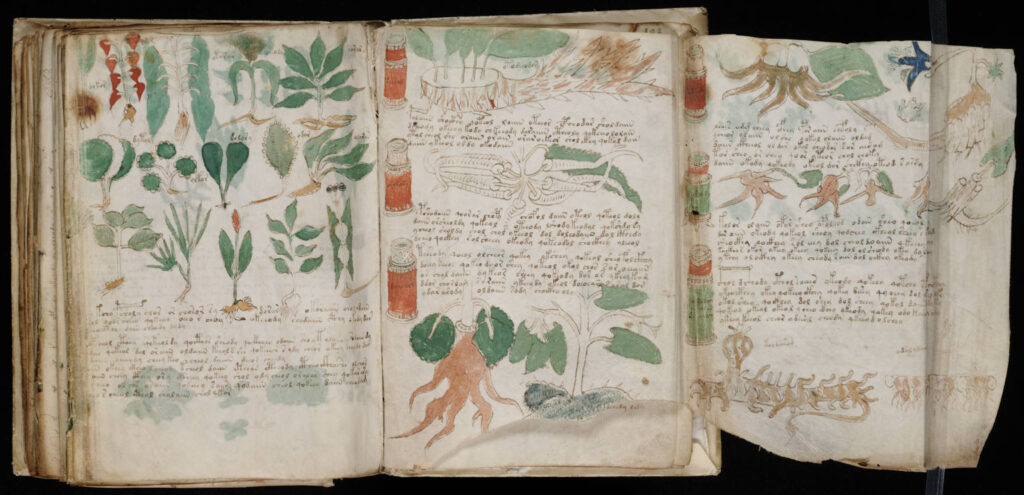
The largest portion of the manuscript contains detailed drawings of plants accompanied by blocks of text. Some illustrations resemble known medicinal herbs, while others combine features from several different species or appear entirely unfamiliar.
This has led to several competing interpretations. Some researchers believe the plants may represent stylized versions of real species, while others suggest they could be symbolic, fictional, or copied inaccurately from earlier sources.
No consensus has been reached, and none of the unidentified plants has been conclusively matched to a real botanical specimen.
Astronomical and Zodiac Pages
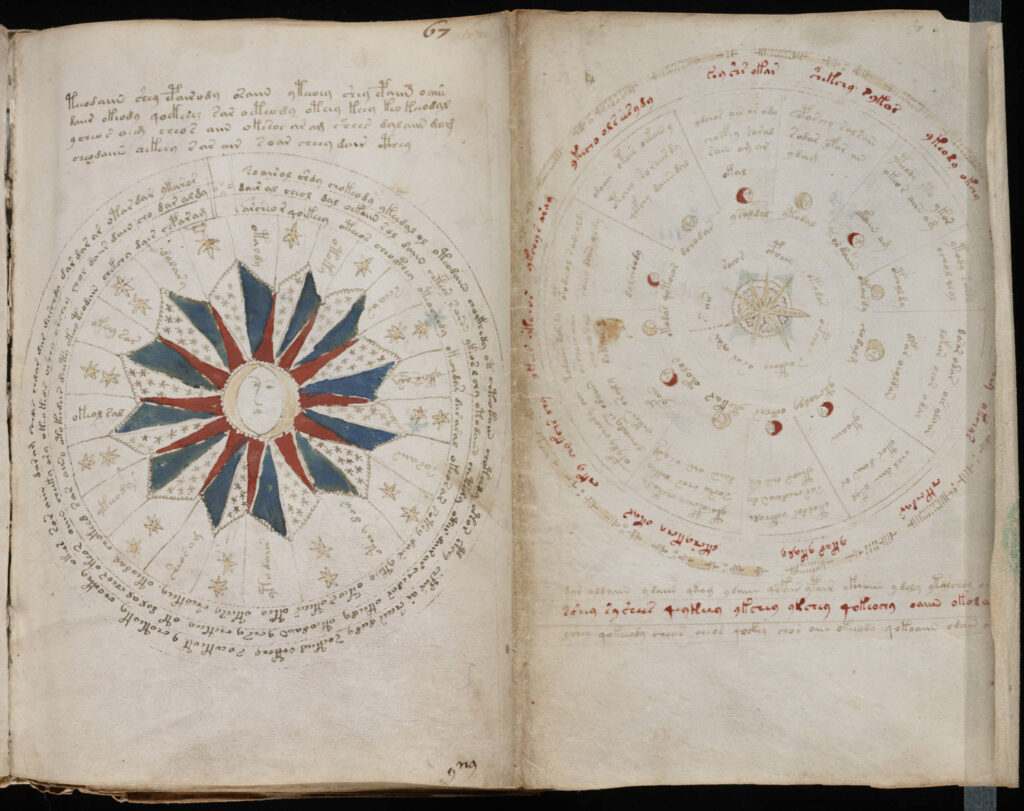
Another section contains circular diagrams featuring stars, suns, moons, and zodiac symbols. Several pages are clearly associated with familiar constellations such as Aries, Taurus, and Pisces, while others display elaborate wheel-like designs whose meaning remains uncertain.
Unlike the botanical pages, these illustrations contain recognizable medieval astronomical symbols. However, the accompanying text remains unreadable, making it impossible to determine whether the diagrams describe calendars, astrology, astronomy, or something entirely different.
Biological Section
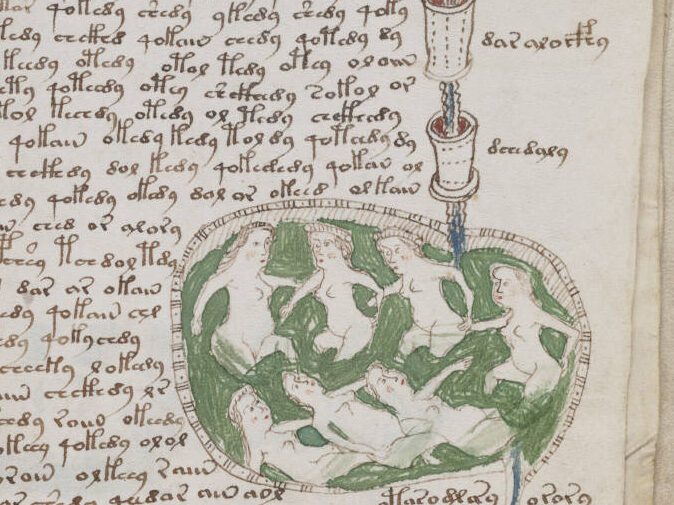
Perhaps the manuscript’s most unusual illustrations appear in what researchers often call the biological section.
These pages depict numerous small female figures bathing in pools connected by an intricate network of green tubes and vessels. Some scholars have suggested that the illustrations relate to medieval medicine, reproduction, or anatomy, while others believe they may represent symbolic or allegorical concepts. Without understanding the accompanying text, none of these interpretations can be confirmed.
The imagery has become one of the manuscript’s defining features and continues to attract both scholarly interest and public curiosity.
Pharmaceutical and Recipe Pages
The final sections contain drawings of containers resembling medieval apothecary jars alongside shorter paragraphs of text.
Many historians believe these pages may have functioned as recipes, medical notes, or references to herbal preparations. If this interpretation is correct, it would place the manuscript within a broader tradition of medieval medical literature.
However, because the writing remains undeciphered, even this seemingly straightforward explanation cannot be verified.
A Script That Defies Translation
While the illustrations immediately capture attention, the manuscript’s writing system has proven to be its greatest challenge.
The text contains approximately 38,000 words written using around 20 to 30 recurring characters, depending on how individual symbols are classified. The script follows remarkably consistent spelling patterns, with certain words appearing only in specific sections of the manuscript. This consistency is one of the strongest arguments against the idea that the text is simply random.
Over the past century, linguists have identified several characteristics commonly found in natural languages:
- frequently repeated word patterns,
- consistent character combinations,
- predictable word lengths,
- recurring prefixes and suffixes,
- grammatical-like structures within individual sections.
At the same time, the manuscript also displays features that do not comfortably match any known language. Certain words repeat far more often than expected, while others appear only once, making direct comparison with medieval Latin or European vernacular languages particularly difficult.
For this reason, most researchers agree on one point: whatever system produced the manuscript, it was highly structured. Whether that structure represents an unknown language, a sophisticated cipher, or something else entirely remains one of the central questions in Voynich research.
The Leading Theories
Although hundreds of explanations have been proposed since the manuscript was rediscovered in 1912, most fall into three broad categories.
Theory 1: An Unknown Language
Many researchers believe the manuscript records a genuine language that has simply not survived into the modern era. Supporters of this theory point to the statistical properties of the text. Word frequencies, repeated character combinations, and sentence structure resemble patterns commonly found in natural languages rather than random sequences of symbols.
If this interpretation is correct, the manuscript may preserve a language that either disappeared without leaving other written records or was intentionally recorded using a unique writing system. However, despite decades of linguistic research, no known language has been convincingly matched to the text.
Theory 2: A Sophisticated Cipher
Another widely discussed possibility is that the manuscript contains encrypted information.
Throughout history, ciphers have been used to protect military plans, diplomatic correspondence, religious writings, and scientific knowledge. Some historians suggest that the Voynich Manuscript could represent an unusually advanced medieval encryption system.
Professional cryptographers—including specialists who worked on military codes during the twentieth century—have examined the manuscript. Although several decoding methods have been proposed, none has produced a translation that has been independently verified or accepted by the wider scholarly community. The cipher hypothesis therefore remains plausible, but unproven.
Theory 3: An Elaborate Hoax
A smaller group of researchers argues that the manuscript may never have contained meaningful text at all.
According to this idea, its creator intentionally produced convincing-looking writing and illustrations to imitate a genuine scholarly work. This explanation raises its own questions. Producing more than two hundred pages of carefully structured text and detailed illustrations would have required considerable time, skill, and expensive materials.
No historical evidence has yet explained who might have created such a work or what practical benefit they would have gained. As a result, the hoax theory remains possible, but it has not become the dominant explanation.
Modern Research
Research on the Voynich Manuscript has changed significantly during the last two decades.
Instead of relying solely on traditional cryptography, researchers now combine several disciplines, including computational linguistics, medieval history, manuscript studies, statistics, and artificial intelligence.
Machine-learning algorithms can compare writing patterns far more quickly than human researchers, while multispectral imaging allows scholars to examine faded pigments and damaged areas of parchment in greater detail.
Although these methods have provided valuable insights into the manuscript’s physical construction and writing patterns, they have not yet revealed its meaning.
Today, most researchers agree that solving the Voynich Manuscript—if it can be solved at all—will likely require collaboration across multiple scientific disciplines rather than a single breakthrough.
Why Does the Voynich Manuscript Continue to Fascinate Researchers?
Unlike many historical mysteries, the Voynich Manuscript is not surrounded by myths because it has disappeared or because only fragments remain.
More than six centuries after it was created, the Voynich Manuscript remains one of the most unusual surviving documents from the medieval world.
Scientific research has answered several important questions. We know approximately when the parchment was produced, where the manuscript is preserved today, and how its text is structured. At the same time, its language—or writing system—has resisted every convincing attempt at interpretation.
Whether future research eventually identifies an unknown language, demonstrates a sophisticated cipher, or supports an entirely different explanation, the manuscript continues to offer an important reminder that not every historical question has been answered.
For historians, that uncertainty is not a weakness. It is precisely what makes the Voynich Manuscript such a valuable subject of ongoing research.
Common Questions About the Voynich Manuscript
Has anyone successfully translated the Voynich Manuscript?
No. Numerous researchers have claimed to decipher the manuscript, but none of the proposed translations has gained broad acceptance within the scholarly community.
How old is the Voynich Manuscript?
Radiocarbon dating indicates that the parchment was produced between 1404 and 1438, placing the manuscript in the early fifteenth century.
Where is the Voynich Manuscript today?
The manuscript is preserved at the Beinecke Rare Book & Manuscript Library at Yale University in the United States, where it has been fully digitized.
Is the Voynich Manuscript written in a real language?
No one knows. Some researchers believe it represents an unknown natural language, while others suggest it may be an encrypted text or another type of structured writing system. At present, no explanation has achieved scholarly consensus.
Can the entire manuscript be viewed online?
Yes. Yale University’s Beinecke Library has made the complete manuscript available as a high-resolution digital collection, allowing anyone to examine every surviving page.