For decades, the so-called Baghdad Battery has been presented as one of history’s greatest unsolved mysteries. According to a popular story, people living in ancient Mesopotamia may have discovered electricity nearly two thousand years before the invention of the modern battery. If true, it would completely change our understanding of ancient technology.
The idea is certainly fascinating. A small clay jar containing a copper cylinder and an iron rod resembles the basic components of a simple galvanic cell. Fill such a container with an acidic liquid, and a measurable electric current can indeed be produced.
Yet archaeology rarely offers such straightforward answers.
More than eighty years after the object first attracted scientific attention, researchers still disagree about what it was actually used for. Some believe it may have generated small amounts of electricity, while others argue that there is no convincing evidence it functioned as a battery at all.
The real story is therefore not about proving that the ancient world had electricity. It is about understanding how a single archaeological find gave rise to one of the most persistent technological myths in popular history.
The Discovery Near Baghdad
The object commonly known as the Baghdad Battery was reportedly discovered during excavations at Khujut Rabu, a site located southeast of modern Baghdad, Iraq.
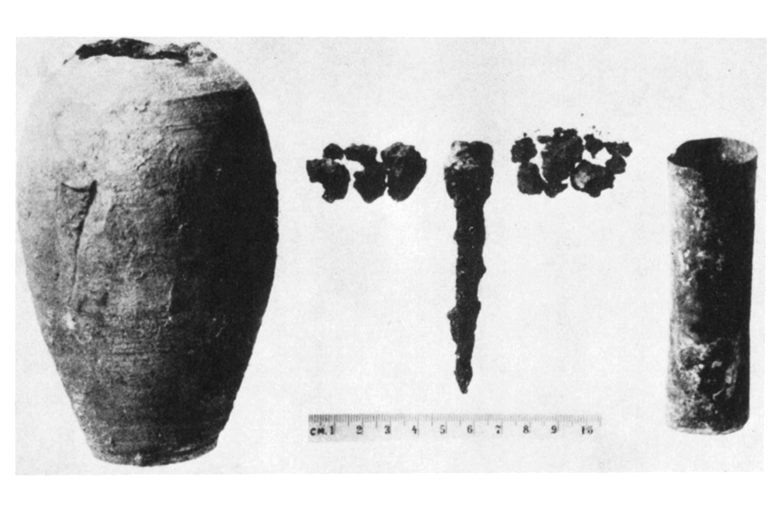
The discovery is generally associated with the German archaeologist Wilhelm König, who published a description of the artifact in the late 1930s while working at the Iraq Museum. König noticed that the unusual combination of a ceramic vessel, a copper cylinder, and an iron rod closely resembled the components needed to produce electricity.
Although the exact archaeological context of the discovery was not documented as thoroughly as modern excavations would require, the object has generally been dated to the Parthian or early Sasanian period, roughly between the first century BC and the third century AD.
Unfortunately, the original artifact is believed to have disappeared during the looting of the Iraq Museum in 2003. Today, researchers rely primarily on historical photographs, published descriptions, and surviving reconstructions when studying the object.
What Does the Artifact Actually Look Like?
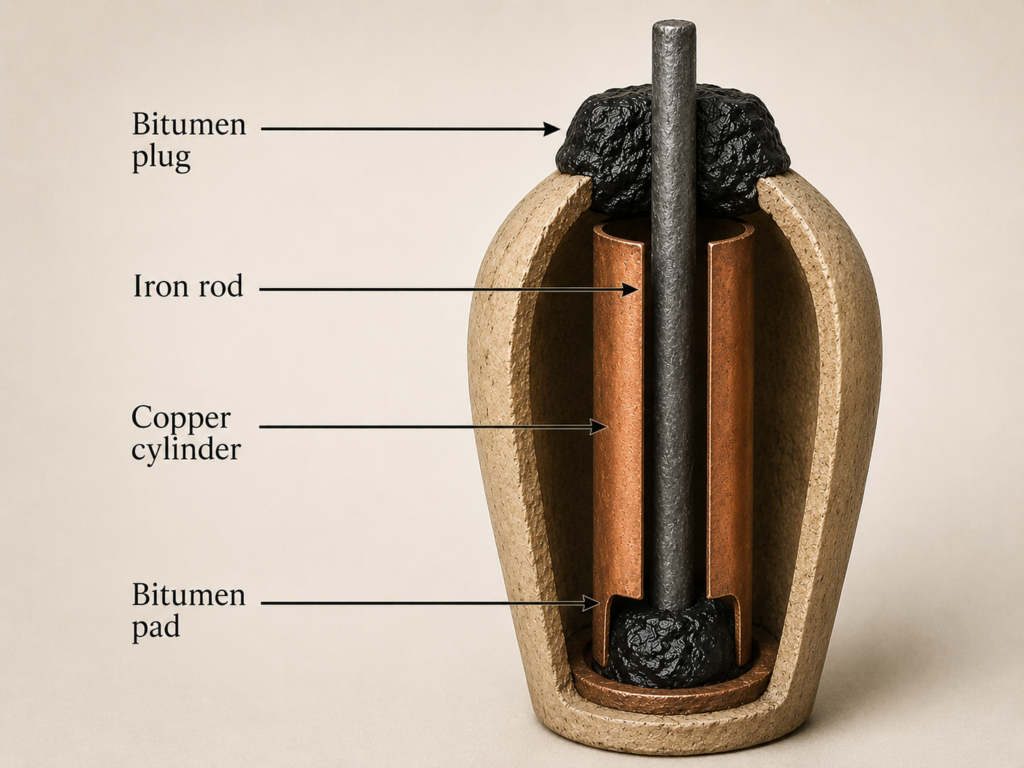
The so-called Baghdad Battery is surprisingly small. It consists of a clay jar approximately 14 centimeters tall. Inside the vessel sits a rolled copper cylinder sealed with bitumen. Suspended within that cylinder is an iron rod, also held in place by bitumen, preventing it from touching the copper.
Viewed purely as a physical object, the arrangement immediately attracts attention because it resembles the structure of a modern galvanic cell. If an acidic liquid such as vinegar, wine, or grape juice were poured into the jar, a small voltage could theoretically be produced between the iron and copper components. Modern replicas have demonstrated that such a setup is capable of generating around one volt under laboratory conditions.
This observation forms the foundation of the famous “ancient battery” hypothesis.
Illustration of the baghdad battery
Did It Really Produce Electricity?
The idea that the Baghdad Battery could generate electricity is not entirely without foundation. In laboratory experiments, researchers have built replicas using clay jars, copper cylinders, iron rods, and acidic liquids such as vinegar or grape juice. These reconstructions have successfully produced a small electrical voltage, usually between 0.5 and 1 volt.
From a purely scientific perspective, the principle works. The difficulty lies elsewhere. Producing a measurable voltage in a modern experiment does not necessarily prove that the ancient artifact was designed for that purpose. Many objects can perform functions that were never intended by their creators. A ceramic bowl can hold water, but that does not mean every ancient bowl was made as a water container.
Archaeologists therefore ask a different question.
Is there any evidence that people in Parthian or Sasanian Mesopotamia actually used electricity?
So far, the answer remains uncertain. No electrical wires, conductive connectors, groups of connected cells, or devices requiring electric current have ever been discovered alongside the jars. Without supporting evidence, the ability to generate electricity remains an interesting observation rather than proof of ancient electrical technology.
If Not a Battery, Then What?
Because the electrical interpretation remains unproven, archaeologists have proposed several alternative explanations.
One possibility is that the vessel served as a storage container for valuable scrolls or sacred objects. The bitumen seal would have helped protect the contents from moisture, while the copper cylinder may simply have reinforced the interior.
Another theory suggests that the object was used for storing religious manuscripts or ritual items rather than generating electricity. Similar containers made from clay and sealed with bitumen are known from other archaeological contexts throughout the region.
Some researchers have also proposed that the vessel may have been part of a workshop, where the copper and iron components served a purpose unrelated to electricity that is no longer obvious because only a single example has survived.
None of these explanations has been conclusively proven.
However, they share one important advantage over the battery hypothesis: they do not require us to assume the existence of a broader electrical technology for which no archaeological evidence has yet been found.
The Electroplating Theory
One of the most popular arguments in favor of the Baghdad Battery suggests that it was used for electroplating—the process of depositing a thin layer of metal onto another object using an electric current.
Supporters of this idea point to the fact that ancient craftsmen were highly skilled metalworkers. Gold- and silver-plated objects have been found throughout the ancient Near East, leading some writers to speculate that electricity may have been used to produce these decorative finishes.
The problem is that electroplating leaves characteristic microscopic traces.
To date, analyses of ancient plated objects from the region have shown that they were produced using well-established mechanical and chemical techniques, such as hammering thin sheets of precious metal over a base object or applying mercury gilding. None requires electricity.
Even if a single Baghdad Battery could generate approximately one volt, practical electroplating would almost certainly require multiple connected cells and a level of technical infrastructure that has never been found archaeologically.
For this reason, most specialists consider the electroplating hypothesis possible in principle but unsupported by the available evidence.
Khujut Rabu (Discovery Site)

How a Scientific Hypothesis Became a Popular Myth
The Baghdad Battery illustrates how scientific ideas can evolve as they move from academic research into popular culture.
Wilhelm König never claimed to have discovered definitive proof that ancient Mesopotamians mastered electricity. He simply observed that the artifact resembled the components of a simple galvanic cell and suggested that this possibility deserved further investigation.
Over time, however, that cautious hypothesis changed. Books, television documentaries, and internet articles often presented the object as established evidence of ancient electrical technology. In many retellings, the uncertainty disappeared entirely, replaced by confident statements that the ancient world had invented batteries thousands of years before Alessandro Volta.
The reality is considerably more nuanced. The artifact can produce electricity under certain experimental conditions, but no convincing archaeological evidence demonstrates that this was its intended purpose. As a result, the Baghdad Battery remains an intriguing possibility rather than a solved historical mystery.
What the Baghdad Battery Really Tells Us
Whether the Baghdad Battery was intended to generate electricity may never be answered with complete certainty. The surviving evidence is simply too limited to allow a definitive conclusion. Yet that uncertainty is precisely what makes the artifact so valuable.
It reminds us that archaeology is rarely about finding simple answers. Instead, researchers must combine physical evidence, historical context, experimental archaeology, and careful reasoning to reconstruct the past. Every new interpretation must be tested against the available evidence, and even the most attractive hypothesis must be abandoned if the evidence does not support it.
The Baghdad Battery also illustrates an important difference between what is possible and what is probable.
Modern experiments have shown that the object can function as a simple galvanic cell under carefully controlled conditions. That finding is scientifically interesting, but it does not automatically reveal why the object was originally made. An experiment can demonstrate that something is possible; it cannot, by itself, demonstrate historical intent.
For now, the most responsible conclusion is that the Baghdad Battery remains an unusual archaeological artifact whose original purpose has not been established. It may have been an early electrical device, a storage vessel, a ritual object, or something else entirely. Until additional evidence is discovered, each explanation remains a hypothesis rather than a historical fact.
In that sense, the Baghdad Battery is not evidence that ancient civilizations possessed forgotten technology. It is evidence that archaeology still contains unanswered questions—and that those questions deserve careful investigation rather than sensational conclusions.
Common Questions About the Baghdad Battery
What is the Baghdad Battery?
The Baghdad Battery is the name given to a clay jar containing a copper cylinder and an iron rod, discovered near Baghdad and dated to the Parthian or early Sasanian period. Its original purpose remains unknown.
Could the Baghdad Battery generate electricity?
Yes. Modern replicas have shown that the combination of copper, iron, and an acidic liquid can produce a small electrical voltage. However, this does not prove that the ancient object was designed for that purpose.
Was the Baghdad Battery really used as a battery?
There is currently no convincing archaeological evidence confirming that it was. Most archaeologists consider the electrical interpretation an interesting hypothesis rather than an established fact.
What other explanations have been proposed?
Researchers have suggested that the vessel may have served as a storage container, a ritual object, or part of another technology unrelated to electricity. None of these interpretations has been conclusively demonstrated.
Why is the Baghdad Battery still important?
Its importance lies not in proving that the ancient world had electricity, but in showing how archaeology works. The artifact demonstrates how scientists test competing hypotheses, evaluate evidence, and distinguish between plausible ideas and historical conclusions.