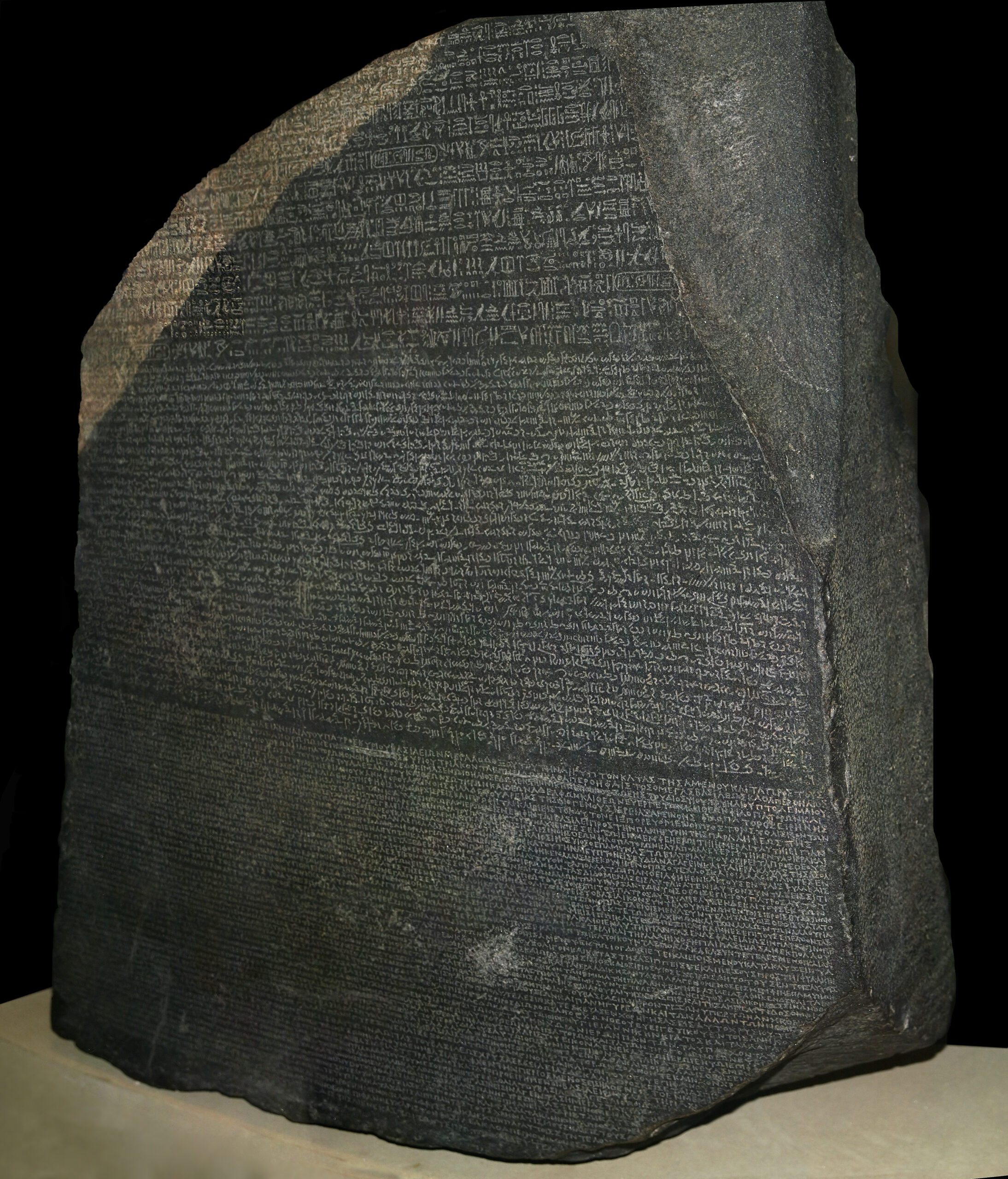
Few archaeological discoveries have changed our understanding of the ancient world as profoundly as the Rosetta Stone.
At first glance, it is simply a damaged slab of dark granodiorite covered with writing. Yet the inscription preserved on its surface became the key that allowed scholars to begin deciphering ancient Egyptian hieroglyphs, a writing system whose meaning had been largely lost to European scholarship for centuries.
The importance of the stone lies in its unusual combination of languages and scripts. The same decree appears in hieroglyphic, Demotic, and ancient Greek. Because scholars could already read Greek, the known text provided a crucial point of comparison for the two Egyptian scripts.
The discovery did not produce an immediate translation. It took decades of work, competing theories, mistakes, and discoveries before scholars finally understood how the hieroglyphic system worked.
The breakthrough is closely associated with the French scholar Jean-François Champollion, whose work in the early nineteenth century transformed the study of ancient Egypt. But the story was not the achievement of one man alone. Other scholars, particularly Thomas Young, made important contributions to understanding the scripts before Champollion’s decisive advances.
The Rosetta Stone therefore represents more than a famous archaeological object. It is a story about how historians recover lost knowledge—and how a single piece of evidence can transform an entire field of study.
Rashid (Rosetta), Egypt — discovery in 1799
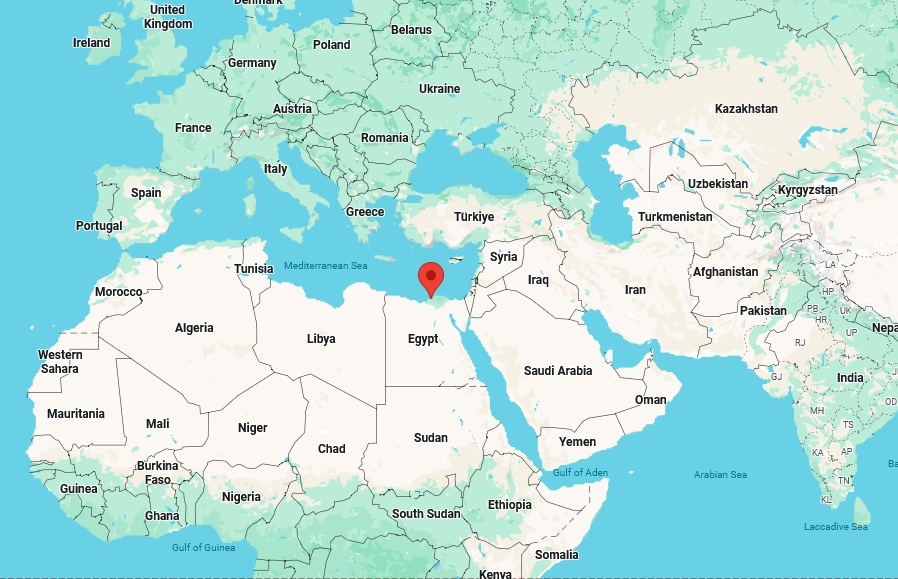
The Rosetta Stone was discovered near the town of Rashid, known in European languages as Rosetta, on the Mediterranean coast of northern Egypt.
The stone was found in 1799 during Napoleon Bonaparte’s Egyptian campaign, when French soldiers were working on fortifications near the town.
It eventually made its way to Britain following the French defeat in Egypt. Since 1802, the stone has been in the collection of the British Museum in London, where it has become one of the museum’s most recognizable objects.
The stone’s journey from northern Egypt to London is itself an important part of its history and reflects the complicated political circumstances surrounding European archaeological collecting in the nineteenth century.
Egypt’s Ancient Writing Systems
Ancient Egypt was home to several different writing systems.
The best known is hieroglyphic writing, whose distinctive signs were used on temples, monuments, tombs, and ceremonial objects. Hieroglyphs could represent sounds, words, and concepts, making the system considerably more complex than a simple alphabet.
Another form, known as Demotic, developed from earlier Egyptian scripts and was widely used for everyday administrative and legal purposes during the later periods of Egyptian history.
By the time the Rosetta Stone was created, Greek had also become an important language of administration and government in Egypt.
This multilingual environment was a consequence of Egypt’s long and complicated political history.
After Alexander the Great conquered Egypt in 332 BC, the country came under Macedonian Greek rule. The Ptolemaic dynasty subsequently governed Egypt for nearly three centuries, combining Greek political traditions with longstanding Egyptian religious institutions.
The Rosetta Stone dates to this period.
The Decree of 196 BC
The inscription on the Rosetta Stone is not a secret message, religious prophecy, or description of the Egyptian gods.
It is a political and religious decree issued in 196 BC during the reign of Ptolemy V Epiphanes.
The decree was produced by Egyptian priests and commemorated the king’s accession and his relationship with the temples and priesthood.
Its importance for modern historians comes not from the content of the decree itself, but from the fact that it was written in three versions.
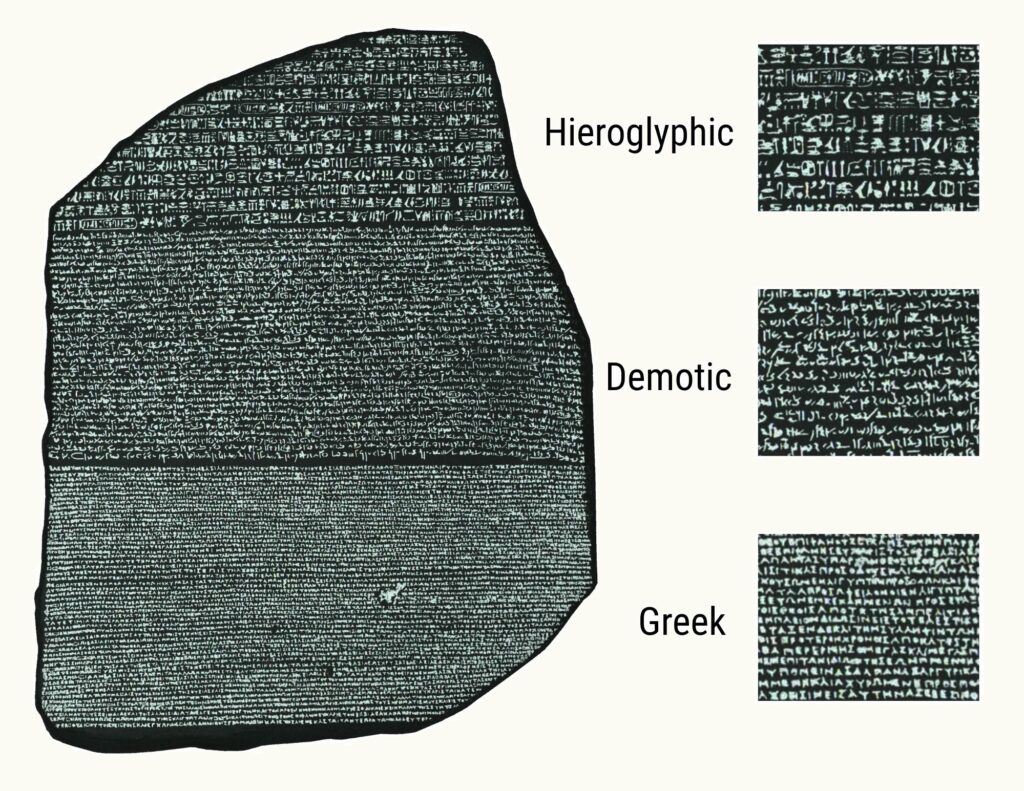
This repetition created the possibility of comparing the unknown Egyptian scripts with a language that scholars could already understand.
It was the archaeological equivalent of finding a bilingual dictionary embedded in stone.
The Discovery in 1799
The Rosetta Stone was discovered in July 1799 during Napoleon’s military expedition to Egypt. French soldiers were strengthening a fort near Rashid when they uncovered the large inscribed stone.
The discovery immediately attracted the attention of scholars accompanying the expedition. The stone was not valuable because of its artistic decoration—it was damaged, incomplete, and relatively plain compared with many Egyptian monuments.
Its importance was the writing. For scholars who had spent centuries attempting to understand the mysterious signs found on Egyptian monuments, the possibility of comparing hieroglyphs with Greek was extraordinary.
The discovery therefore transformed what had previously been a largely theoretical problem into a practical one. If the three texts represented the same decree, scholars could potentially use the known Greek version to identify words and names in the Egyptian scripts.
That assumption would prove correct—but deciphering the system would be considerably harder than anyone initially expected.
A Race to Read the Stone
The discovery of the Rosetta Stone triggered an international scholarly effort to understand the inscription. French and British researchers produced copies and casts of the stone so that scholars who could not examine the original could still work on the text.
One of the most important figures in the early stages of the investigation was the English scholar Thomas Young.
Young correctly recognized that some groups of hieroglyphs enclosed in oval shapes—known as cartouches—represented royal names. His work helped establish that hieroglyphs could represent sounds rather than functioning solely as symbolic pictures. However, decipherment remained incomplete.
The breakthrough eventually came from the French scholar Jean-François Champollion, who had devoted years to studying Egyptian writing and the Coptic language.
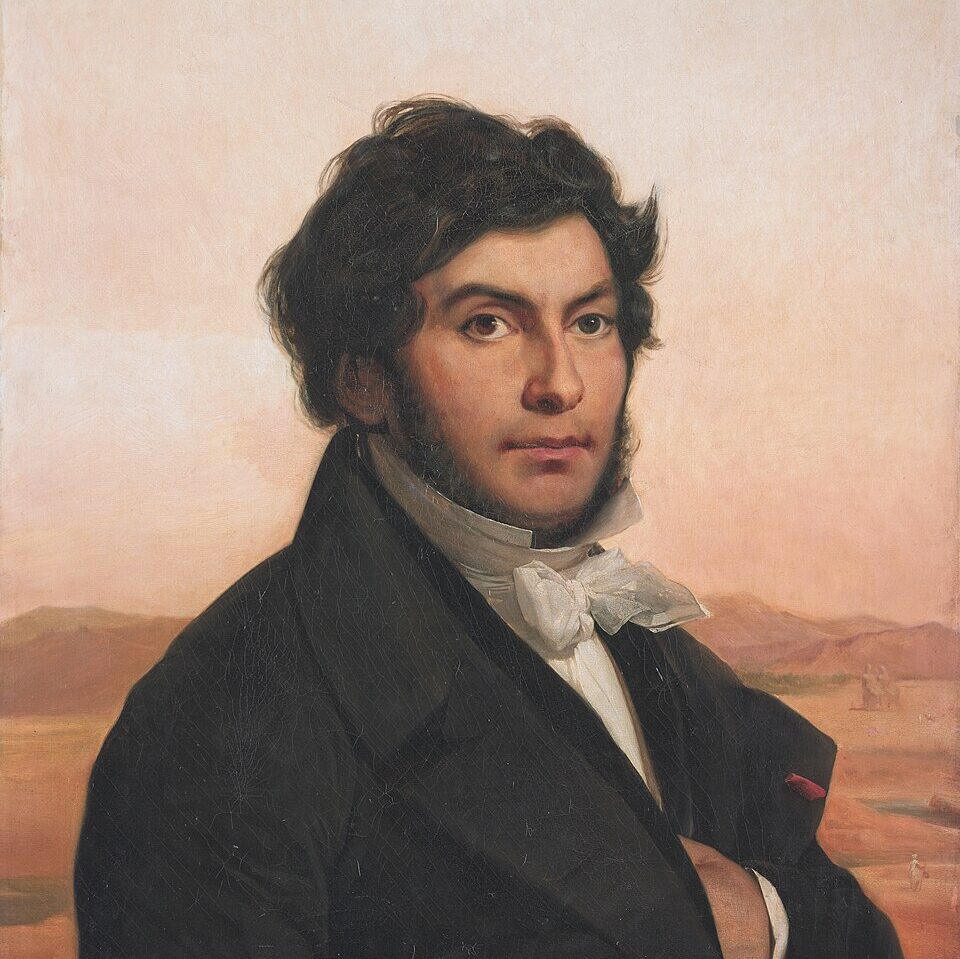
The British Museum’s research on the decipherment emphasizes that the Rosetta Stone provided the key to understanding hieroglyphs, but also highlights the contributions of both Young and Champollion to the eventual breakthrough.
Why the Rosetta Stone Changed History
The decipherment of Egyptian hieroglyphs did something much more important than allowing scholars to translate one ancient inscription. It opened an enormous historical archive.
Once Egyptian writing could be read with increasing confidence, historians could finally access thousands of inscriptions, administrative documents, religious texts, royal records, private letters, and monumental inscriptions that had survived for millennia.
Ancient Egypt was no longer known primarily through monuments and later Greek and Roman accounts. Egyptians could, in effect, begin to speak for themselves. The Rosetta Stone therefore became a turning point in the study of one of the world’s oldest civilizations.
And yet the famous stone was only the beginning. The actual decipherment was the result of decades of scholarship, comparison, linguistic analysis, and careful correction of earlier assumptions.
The Breakthrough: Champollion and the Sounds of Hieroglyphs
The decisive breakthrough came in the early nineteenth century, when scholars began to understand that Egyptian hieroglyphs did not simply represent ideas or objects. Some signs represented sounds.
This realization was fundamental. A picture of an animal, person, or object could sometimes function as a phonetic sign, while other signs helped clarify the meaning of words. Hieroglyphic writing was therefore a complex system combining phonetic and semantic elements.
Thomas Young had already made important progress. By comparing the Greek text with groups of hieroglyphs inside royal cartouches, he identified signs corresponding to the name Ptolemy.
His work demonstrated that at least some hieroglyphs represented sounds. But Young did not develop the complete system. That achievement is generally associated with Jean-François Champollion, who built on earlier scholarship and used his knowledge of Coptic, the later form of the Egyptian language preserved in the Coptic Christian tradition.
Champollion understood that the language represented by the ancient scripts was connected to Coptic. This allowed him to approach the hieroglyphs not merely as symbols but as a written form of an actual language.
In September 1822, Champollion announced his breakthrough to the French Académie des Inscriptions et Belles-Lettres. His work demonstrated that hieroglyphic writing could represent the sounds of the Egyptian language.
The British Museum dates the crucial decipherment breakthrough to 1822, while its educational materials note that the work of Champollion, Young, and other scholars continued to develop the system in the years that followed.
How Egyptian Hieroglyphs Actually Work
One of the most persistent misconceptions about hieroglyphs is that every picture represents an idea. A bird is not necessarily simply “bird.” A particular bird sign might represent a sound, a word, or serve another grammatical function depending on its context. The system could therefore operate at several levels simultaneously.
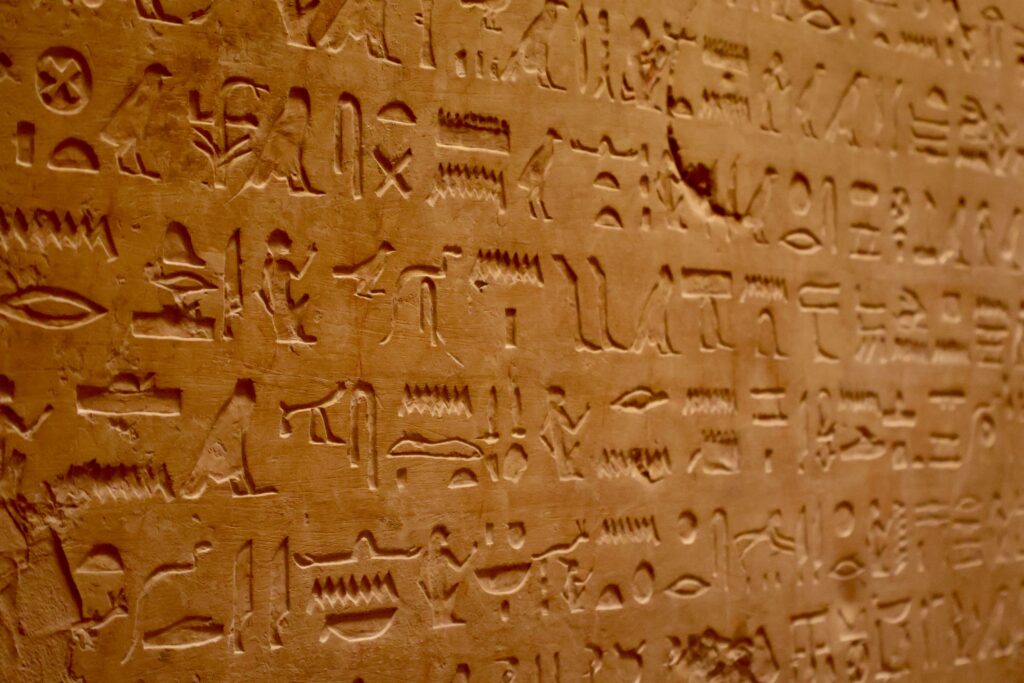
Some signs represented individual sounds or groups of sounds. Other signs functioned as determinatives, helping clarify the meaning of a word without necessarily being pronounced.
This complexity explains why deciphering hieroglyphs was such a difficult task.
The Rosetta Stone did not provide scholars with a simple symbol-by-symbol translation table. Instead, it provided a crucial body of parallel text that allowed researchers to test hypotheses about how the Egyptian scripts worked.
Once scholars established a growing number of phonetic values, they could compare those values against royal names and other inscriptions.
The process gradually expanded. A name that could be identified with confidence provided new letters. Those letters could then be tested against other words. New words revealed grammatical patterns. Those patterns made it possible to interpret longer inscriptions.
Decipherment therefore became a cumulative process rather than a single moment of translation.
What Does the Rosetta Stone Actually Say?
The inscription is a political and religious decree issued in 196 BC, during the reign of Ptolemy V Epiphanes.
The young king had inherited a difficult political situation. Egypt was experiencing internal unrest, and the Ptolemaic monarchy needed the support of powerful Egyptian temples and priesthoods.
The decree records the priests’ recognition of Ptolemy V and lists benefits and actions attributed to the king. It also establishes honors for him and instructions concerning his representation in temples.
The text was not unique to the Rosetta Stone. The decree was intended to be reproduced on stone stelae and displayed at temples throughout Egypt. Other examples of the same decree have subsequently been identified.
This is an important detail because the Rosetta Stone is often portrayed as a unique ancient “translation key.”
It was not.
The stone is a surviving copy of a wider political decree, and other copies have helped scholars reconstruct portions of the text missing from the damaged Rosetta Stone itself. The British Museum currently records multiple related examples of the decree.
The famous stone is therefore important because of its surviving combination of scripts—not because the decree itself was an isolated document.
Three Scripts, Not Three Languages
Another common misconception is that the Rosetta Stone contains three different languages.
In fact, the decree is written in two languages but three scripts.
The languages are:
- Egyptian
- Ancient Greek
The Egyptian language appears in two different writing systems:
- Hieroglyphic
- Demotic
Ancient Greek forms the third section.
The distinction matters because the three sections were not three unrelated translations. They conveyed the same decree using writing systems suited to different audiences and purposes.
Hieroglyphs were appropriate for a formal priestly monument. Demotic was a more cursive Egyptian script used widely in administrative and everyday contexts. Greek was the language of the Ptolemaic ruling elite and administration.
The British Museum identifies the surviving inscription as 14 lines of hieroglyphs, 32 lines of Demotic, and 54 lines of Greek in its collection record, although the precise surviving line count can vary slightly between descriptions depending on how damaged portions are counted.
The Rosetta Stone Was Only Part of the Story
It is tempting to imagine that scholars discovered the stone in 1799, translated the Greek section, and immediately understood the hieroglyphs.
The reality was much more complicated. The stone provided an essential piece of evidence, but decipherment required scholars to develop an understanding of Egyptian grammar, vocabulary, phonetics, and writing conventions. Researchers also needed other inscriptions.
Once a small number of names and words could be identified, scholars could compare them with inscriptions on temples, statues, coffins, papyri, and other monuments. The decipherment therefore expanded far beyond the Rosetta Stone itself.
This is one reason the achievement is better understood as the beginning of modern Egyptology rather than simply the translation of one ancient artifact.
From a Single Stone to an Entire Civilization
The consequences were enormous.
Before hieroglyphs could be read, historians had to rely heavily on archaeology, artistic interpretation, and accounts written by later Greek and Roman authors.
After decipherment, ancient Egyptian texts became historical evidence in their own right. Royal inscriptions revealed political events and royal ideology. Temple inscriptions preserved religious traditions. Tomb texts provided information about beliefs concerning death and the afterlife. Administrative documents revealed aspects of taxation, agriculture, trade, and government. Personal texts offered glimpses into the lives of people who would otherwise have remained almost completely anonymous.
The ancient Egyptians had left behind an enormous written record. The problem was that for centuries, much of it could not be understood. The Rosetta Stone helped change that.
The Stone’s Modern Journey
The Rosetta Stone’s story did not end with its role in decipherment.
After the French defeat in Egypt in 1801, the stone was surrendered to the British and transported to Britain. It entered the collection of the British Museum in 1802, where it has remained one of the institution’s best-known objects.
Today, the original stone is displayed in the museum’s Egyptian Sculpture Gallery. Its modern history is also part of a broader debate about the ownership and movement of archaeological objects during European imperial expansion.
Egypt has repeatedly called for the return of the Rosetta Stone, arguing that the artifact should be displayed in Egypt. The British Museum has retained it as part of its collection.
For The Veil of History, this aspect of the story is worth including because the Rosetta Stone is not simply an ancient artifact. Its modern journey reflects the complicated relationship between archaeology, colonialism, museums, and cultural heritage.
Why the Rosetta Stone Still Matters
The significance of the Rosetta Stone extends far beyond ancient Egypt. It has become a universal symbol of decipherment.
The phrase “Rosetta Stone” is now commonly used to describe anything that provides the crucial clue needed to understand something previously difficult or impossible to interpret.
But the real story is more interesting than the metaphor. The stone did not magically reveal a forgotten language. It provided evidence.
Scholars then spent decades comparing texts, testing hypotheses, identifying phonetic values, studying grammar, and correcting one another’s mistakes.
That distinction is important. Historical knowledge is rarely unlocked by a single discovery alone. More often, an important discovery gives researchers the evidence they need to ask better questions.
The Rosetta Stone did exactly that.
Common Questions About the Rosetta Stone
What is the Rosetta Stone?
The Rosetta Stone is a fragment of a larger stone stela containing a priestly decree concerning Ptolemy V, written in hieroglyphic, Demotic, and Ancient Greek. It was created in 196 BC.
Why is the Rosetta Stone so important?
Its parallel inscriptions gave scholars crucial evidence for deciphering Egyptian hieroglyphs and ultimately made it possible to read a vast body of ancient Egyptian texts.
Who deciphered the Rosetta Stone?
Jean-François Champollion is generally credited with the decisive breakthrough in deciphering Egyptian hieroglyphs in 1822, although Thomas Young and other scholars made important contributions before and alongside his work.
Does the Rosetta Stone contain three languages?
No. It contains two languages—Egyptian and Ancient Greek—written in three scripts: hieroglyphic, Demotic, and Greek.
What language is Demotic?
Demotic is a cursive form of the Egyptian writing tradition that was widely used in later ancient Egypt, particularly for administrative and everyday purposes.
Where is the Rosetta Stone today?
The original is held and displayed at the British Museum in London. The museum’s collection identifies it as object EA24.
Was the Rosetta Stone the only copy of the decree?
No. Other copies and closely related versions of the decree have been discovered in Egypt. These additional inscriptions have helped scholars reconstruct portions of the text that are damaged or missing from the Rosetta Stone.